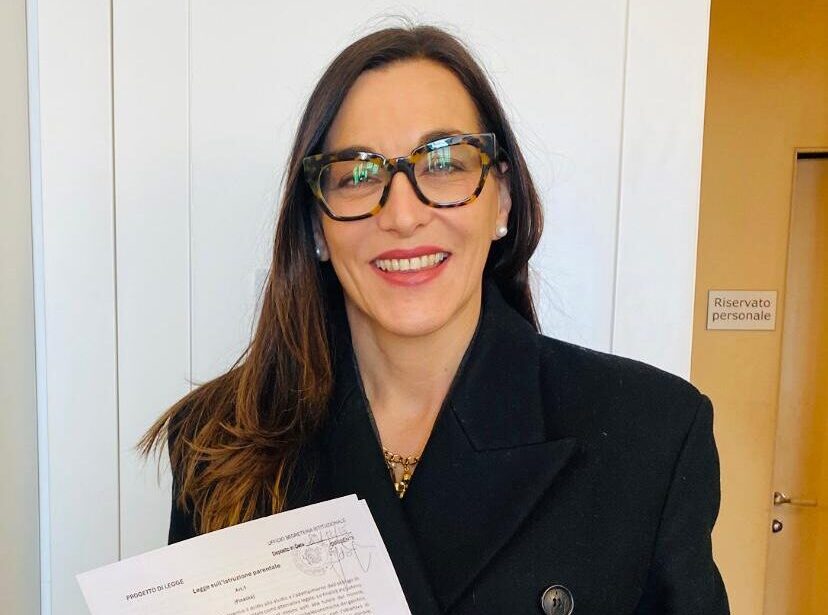
We have received and are publishing a reflection by Michela Pelliccioni (independent councillor) titled “ICEE was meant to ensure fairness. Now it risks becoming a tool to control citizens.”
__________________________
It was supposed to be a tool for fairness. It risks becoming a tool through which the State reaches into families’ bank accounts, into children’s savings, and even into citizens’ investment choices. And all this while the software doesn’t work and the political objectives remain unclear.
I have always been in favor of a more equitable distribution of State contributions, so that public resources go first and foremost to those who truly need them. It was with this conviction that I approached the debate on ICEE in the Chamber.
But what we find ourselves facing today, with the introduction of the Income and Asset Declaration (Dichiarazione Reddituale e Patrimoniale, DPR), raises questions we cannot ignore. Not only regarding privacy protection, but also regarding the real purposes of a tool that seems to have drifted away from the spirit in which it was discussed and approved.
Politics has in fact chosen to make this declaration mandatory for access to utility bill installment plans, contributions for the right to education, and even merit-based scholarships for students.
And it is precisely on this last point that I believe a line is being crossed.
Do we really want to tie the recognition of academic merit to the economic situation of the family a student belongs to?
If a student achieves excellent results, does their effort count for less because they were born into a well-off family? And conversely, should we be teaching young people that merit is only rewarded when accompanied by economic disadvantage?
This is not the principle that should guide policy that cares about young people and their future. Merit must be recognized for what it is, regardless of parents’ income. For this reason, in the upcoming budget law, I will table a specific amendment so that merit-based scholarships are awarded to those entitled to them based on the results they have achieved, without further economic conditions attached.
And while we debate all this, a very concrete problem remains: the software doesn’t work. This is the first, major issue to address on the operational level.
But we cannot simply talk about a technical glitch. We must question the political choices that led to the construction of such a complex tool. Why did we want to go far beyond assessing income capacity, introducing parameters that seem to have little to do with disposable income and much more to do with a desire to know every detail of people’s financial situation?
I am thinking in particular of the monitoring of average bank account balances — even those held by minors — financial investments, and even the type of investments chosen.
Who benefits from all this?
Do we really want to discourage a grandparent who decides to set aside savings to give their grandchildren the chance to study? Should we consider it a penalty for a family, even one with modest income, that has tried over the years to build a small financial reserve in their children’s names?
Savings and the ability to plan for the future cannot automatically become grounds for penalization.
There is also a question concerning our financial system. At a time when we need to support investment diversification and strengthen savers’ confidence, there is a risk that these very policy choices will produce the opposite effect — discouraging virtuous behavior and fueling distrust of investment instruments in San Marino.
But the more important political question is another one: who needs this data, and above all, who is actually capable of managing it, protecting it, and interpreting it?
Collecting such a vast amount of personal and financial information carries an enormous responsibility. It is not enough to acquire the data: it requires expertise, structures, oversight procedures, and strict confidentiality guarantees. We cannot assume that simply having access to information automatically translates into the ability to use it correctly for its stated purposes.
This is where a fundamental problem arises for San Marino: what are the concrete objectives of ICEE? What information is truly indispensable to achieve them? And what guarantees are offered to citizens regarding its use?
This clarity must first be provided to the political sphere — to those who sit in the Chamber and bear the responsibility of debating and voting on laws. Because I have the feeling that the tool we are now applying has taken on characteristics and purposes that do not fully match the spirit and objectives of the text discussed and approved in Parliament.
We cannot ask citizens to hand over such sensitive information without first making clear why we are asking for it, what it is used for, who uses it, and what results we intend to achieve.
What is needed is a political agreement on objectives, even before the technical work on the software. What is needed is a forward-looking vision, one capable of distinguishing what is necessary from what is simply possible to collect.
Because fairness is a just and worthy goal. But it cannot become a pretext for indiscriminate control over people’s economic lives.
In a small country like San Marino, the line between the need to know and the curiosity to find out is particularly delicate. And the risk is that, without clear objectives and adequate safeguards, someone’s curiosity ends up prevailing over everyone’s fairness.
Michela Pelliccioni
Independent Councillor