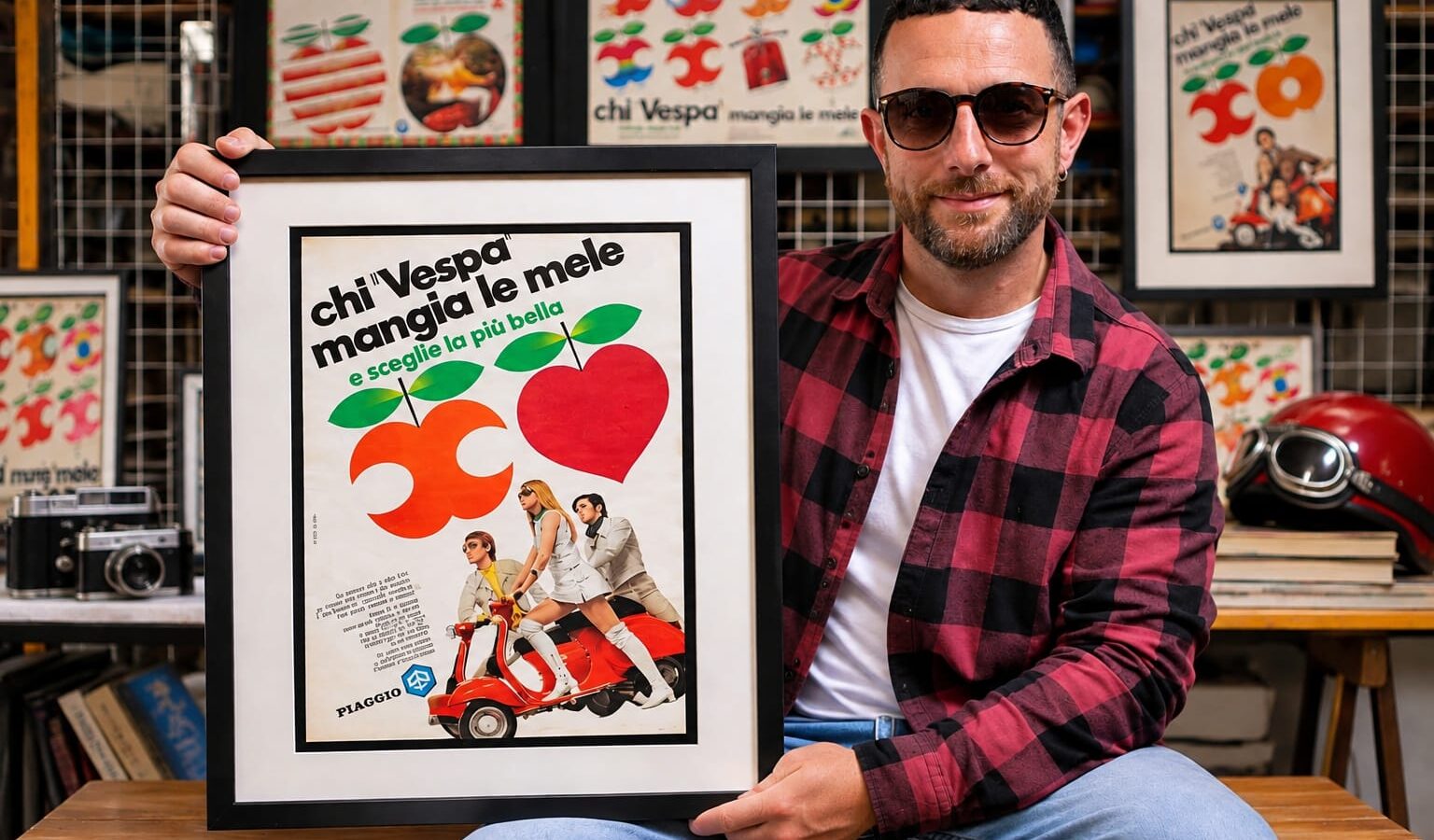
Lorenzo Amadori is the founder of MyNumi and owner of Titano Collezioni, a San Marino-based company specialising in numismatics, vintage advertising, posters, magazines and collectible items.
For over 20 years he has been recovering, studying and showcasing artefacts of 20th-century visual culture, using images and objects to tell the story of how advertising, consumption and society have changed over time.
With his column Behind the Slogan, he takes readers on a journey through the stories and curiosities hidden behind the advertisements that defined an era.
________________
Some slogans sell a product. Others become songs, lodging themselves in the collective imagination and refusing to fade with time.
That is exactly what happened in the 1960s with a simple advertising line destined to become one of the most famous in Italian history: “Chi Vespa mangia le mele” (“Those who ride a Vespa eat apples”).
Four words that would cross generations, eventually resurfacing years later even in a song by Vasco Rossi.
By the end of the 1960s, Italy was changing. Young people had more freedom, more money to spend and, above all, a growing desire to distinguish themselves from their parents’ generation.
Buying a means of transport was no longer enough: what people wanted was to buy into a lifestyle. It was in this very context that one of the most celebrated advertising campaigns in Italian history was born — one capable of turning a scooter into something far bigger than itself.
“Chi Vespa mangia le mele” was a brief phrase, yet powerful enough to etch itself into the country’s collective memory. But what did it actually mean? To understand it, we need to return to the Italy of that era, when advertising was beginning to speak more and more directly to younger generations — to their desires and their urge to break with convention.
The apple, in fact, was no random choice. In the cultural imagination it represented desire, temptation and the choice to break the rules. It was an ironic nod to the forbidden fruit, an instantly recognisable symbol that conveyed a precise message without ever needing to spell it out. Whoever chose a Vespa was modern, independent, young. In short, those who rode a Vespa dared a little more.
What is striking is that the campaign said nothing about engines, speed or fuel consumption. It spoke about identity. A concept that seems obvious today, but which at the time represented a genuinely new way of doing advertising.
The Vespa became the symbol of a generation eager to move, travel, meet people and embrace change.
It was no longer simply a means of getting around, but a way of telling the world who you were — and, more importantly, who you wanted to become.
That simple phrase worked so well it outlived the advertising campaign itself. Because once a slogan enters everyday language, it stops being mere advertising and becomes culture. This is one of the most fascinating aspects of the story of “Chi Vespa mangia le mele”: its ability to condense the spirit of an entire generation into just four words.
The idea was clever for another reason too. In an Italy that was still quite conservative, speaking openly about desire, freedom and transgression would have been unthinkable.
So the creatives behind the campaign chose a metaphor instead: the apple, the forbidden fruit. A symbol everyone could understand, yet one that no one could openly object to.
It was precisely thanks to that ambiguity that the slogan managed to slip past the cultural constraints of its time and become one of the most famous in Italian advertising history.
But the story doesn’t end there. About twenty years later, Vasco Rossi picked up the slogan and transformed it into the famous line “Chi non Vespa più si fa le pere” — a play on words in which “farsi le pere” is Italian slang for shooting up heroin. This time, the metaphor gave way to a far more explicit reference, carrying a meaning quite different from that of the original campaign.
And here lies a curious irony of history. What advertising had managed to achieve without ever falling foul of censorship, the song could not avoid.
A slogan born to sidestep the constraints of its era ended up being remembered partly thanks to a song that, by contrast, collided head-on with those very constraints.
Two different languages — advertising and music — united by the same phrase and by its shared power to provoke.
Perhaps this is the true secret of great advertising campaigns: they don’t just sell an object, they sell an idea, an emotion, an identity. The Vespa may have been a scooter, but in the minds of Italians it was so much more.
It was freedom, youth, the urge to set off without knowing exactly where you were headed.
It was the desire to live through a new season, one in which even a simple means of transport could become the symbol of social and cultural change.
And that is why, more than half a century on, we still remember those four words: “Chi Vespa mangia le mele.” A slogan that outgrew the boundaries of advertising to become part of everyday language, of music, and of the memory of generation after generation.