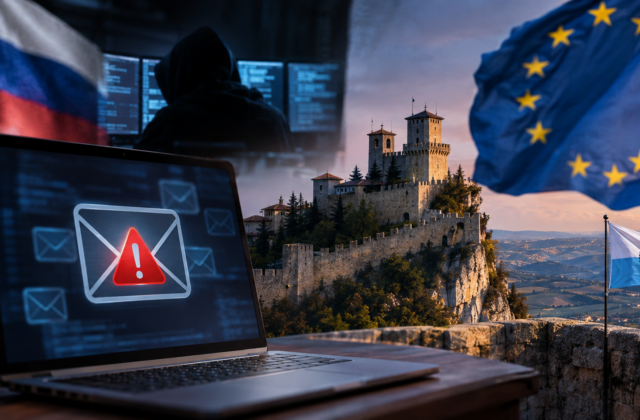
Cyberattacks on supermarket refrigeration systems, bomb threats on flights, threats against television broadcasters.
The episodes of recent days have brought the issue of hybrid warfare back to the fore: hostile actions capable of destabilising a country by striking its infrastructure, communications and public opinion.
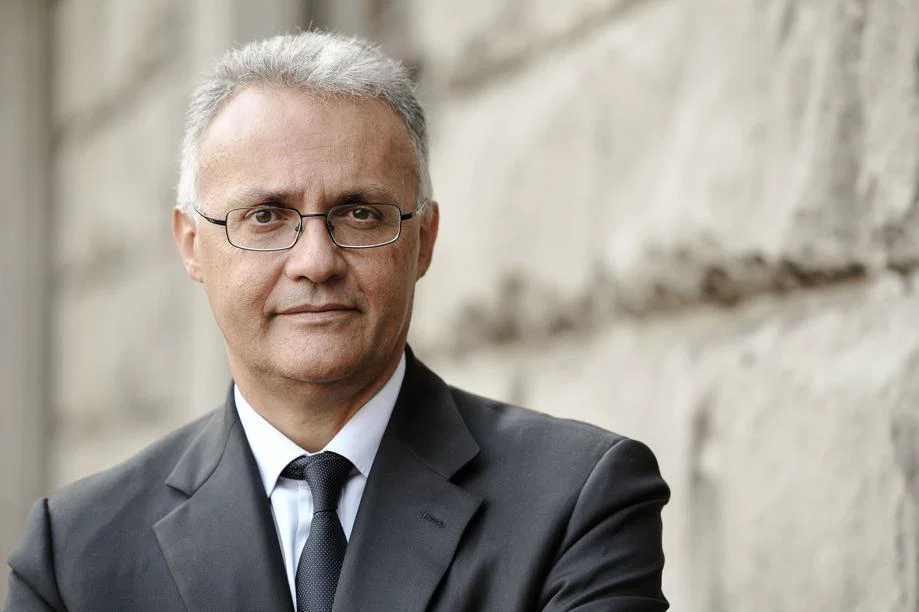
We discussed the issue with Mario Mauro, Italy’s Minister of Defence from 2013 to 2014, former Vice-President of the European Parliament and currently European coordinator for the Baltic Sea–Black Sea–Aegean Sea transport corridor. His analysis begins with the need to recognise these threats and build a united European response, extending to the contribution that even San Marino can offer on the diplomatic front.
What should we understand by hybrid warfare? Is it truly a different condition from the wars we have known in the past?
“We should have the courage to call things by their name.
I belong to a generation that lived for decades under the so-called Cold War. Cold as it was, it was a war in every respect: ideological, waged through communication, disinformation, and what we would today call fake news.
It could also open up unsettling scenarios, when the deterrence standoff took a qualitative leap forward, as happened during the Cuban missile crisis.
Today’s situation is no different. We call it hybrid warfare: a series of hostile acts aimed at destabilising the opposing side in order to gain an advantage in terms of influence and control over global scenarios, and to shift the balance of power between states.
In Western countries, public consensus is decisive for achieving power. That is why governments tend to refuse to say, and to acknowledge, that they are at war”.
How do you read the current international balance of power? Why does Europe risk being left on the margins?
“Russia, which had secured an enormous competitive advantage through the Yalta agreements, is seeking to restore that balance. The United States, unlike the posture that characterised it for decades, now sees an advantage in handing back to Russia a share of influence over the European chessboard.
This frees it from the role of guardian of the world and allows it greater freedom to operate in the Pacific theatre and to return to its own backyard, through a Trumpian reissue of the Monroe Doctrine.
Europe is outside these games and must ask itself seriously what it actually wants.
If it wants to accept a scenario that reproduces Yalta once again, it must also accept the idea that at least part of itself, probably the most exposed part, will end up within Russia’s sphere of influence. If it seeks an alternative, it is forced to play an entirely different game”.
You identify the European Union as a central obstacle to Russian ambitions. Why is that?
“Consider this: it was not NATO, but the European Union, that took territory and influence away from Russia. And, remarkably, it did so through the very principles of the European project: through an attractive model that convinced the populations of former Eastern Bloc countries to join the project and to aspire to that way of life.
It is the European Union that represents the real danger to Russia.
This became clearer after the Maidan events of 2014: although it kept repeating ‘NATO, NATO’, the Russian Federation’s target increasingly became the framework of competitive democracies within the European Union.
We need to move forward together, without deluding ourselves that we can negotiate with the world’s great powers by playing a solitary game, each for itself”.
How much do disinformation and differing national sensitivities affect Europe’s difficulty in producing a common response?
“Let’s start from the facts: awareness of this global confrontation, particularly with Putin’s Russia, is more acute in countries closer to Russia. In those countries, awareness of the Russian threat and of service to the homeland is a pillar of public discourse.
As one moves further away, that sensitivity changes radically. This is also the result of powerful disinformation and internal political factors: governments that are more aware of the war are at greater risk, because they can more easily lose the support of their own populations.
It is a political and cultural fragility. We must listen to the other side’s reasoning, while remaining firm that we cannot allow the other side to trample on international law and subordinate peoples’ self-determination to its own whims or its own project of power.
Calling things by their name is the opposite of disinformation, and it is also a source of strength for an active diplomacy — one that does not withhold support from those in difficulty and works to ensure that the logic of force does not prevail, but rather the force of reason”.
The attacks on refrigeration systems and the alerts on aircraft touch people’s everyday lives directly. What can a strategy of this kind produce?
“What we call hybrid warfare is in fact one of the cruellest mechanisms of the art of war: the attempt to sow fear by striking at people’s everyday lives. Anything that depends on electronics, that is linked to networks, to communication and, in a word, to cyberspace, can plunge populations into a state of great anguish and fear.
In the case of the war in Ukraine, we are witnessing an attempt by Russia to use terror to shift the balance of public consent within the country.
The consequences of this strategy are unpredictable, but it is certainly the most painful of all strategies.
A key element is also sowing discord, fostering polarisation and political conflict within European Union countries”.
How should we respond in practical terms? What are the priorities for securing Europe?
“We need to think about what is already being done and prepare together. The world of information too, in countries like Italy, France, Spain and Portugal, is called upon to escape the trap of Russian propaganda and give citizens truthful reporting.
These aspects should not be underestimated.
While Europe’s wealth lies in its diversity, we must strategically strengthen our infrastructure and protect it in terms of resilience.
We must defend railways, roads, motorways, ports, airports, communication hubs and the information system. There is a great deal to be done, and it makes no sense to use the word ‘weapons’ in a generic way.
Securing Europe and its economy is a task much more akin to that of the third of the three little pigs: the only one who took the trouble to build his house of bricks, fearing that the wolf would come”.
In this scenario, what space remains for diplomacy and for the contribution of small states?
“Alongside this awareness comes the duty to work for peace.
It is not necessarily only the ‘good guys’ who play this game: even tough figures, yet aware of what the global scenario is risking — such as Erdoğan, Mohammed bin Salman and the Israelis themselves — are seeking to secure new balances.
What is needed is that capacity, typical also of small states, to understand that what is placed on the scales must include not only weapons, not only money, not only demographic figures, but also a substance of thought capable of weaving together these balances into a shared project.
In this sense, I believe San Marino too can and must make its contribution”.
Is San Marino also exposed to these power games? And what role can it play in light of the Association Agreement with the European Union?
“San Marino, like Italy as a whole, is naturally a candidate to end up caught in the power games of countries such as Russia, China and the United States. From this point of view, there is no difference.
But San Marino holds a new card to play, also through its association relationship with the European Union: a form of relationship that, albeit in a different context, also concerns Ukraine.
It therefore has every possibility, and every responsibility, to make its voice heard and perhaps to offer itself as a symbolic venue for moments of exchange of views and for shaping the most appropriate next steps.
San Marino, together with the other small states of the world, is by definition an emblem of the validity of multilateral mechanisms, starting with the United Nations.
In my view, it is time — just as it skilfully played its hand in the association with the European Union — for it to play its part on the ground of peace and war as well”.