There is a line, in the interview that David McCloskey gave to Gigi Paoli, that deserves to be taken more seriously than its bestseller-ready tone might suggest.
The former CIA analyst, now a spy-novelist translated around half the world, says that hybrid warfare in Europe “is a real threat.”
This is not the hyperbole of a writer hunting for plot material. It is a description of what, week after week, is happening in our cities, our airports, even in the refrigerated aisles of our supermarkets.
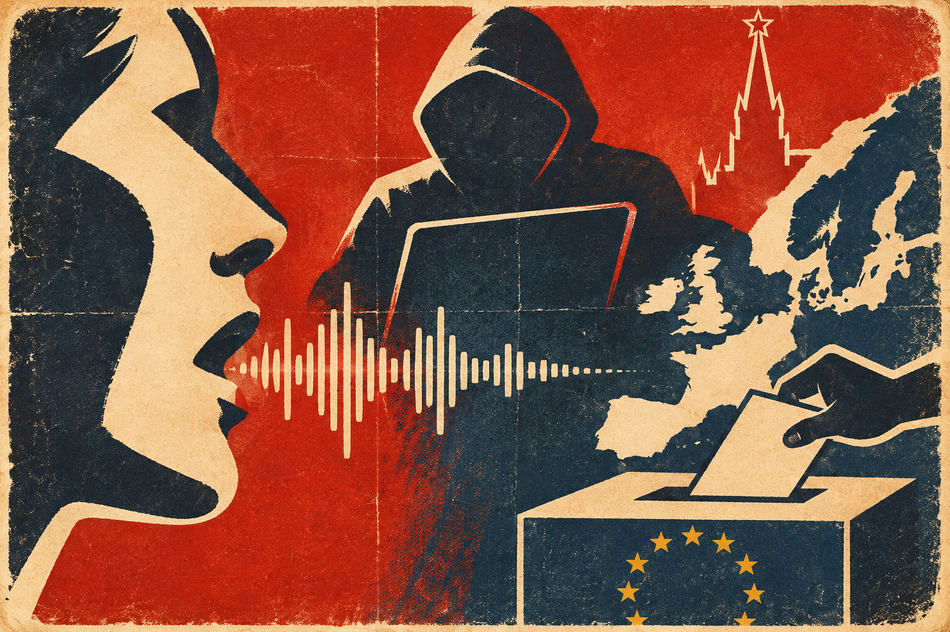
The starting point of McCloskey’s analysis is simple: Moscow doesn’t need troops to strike Europe. Destabilization is enough, and for that it can rely on criminal muscle for hire, since a fire or a drone can be outsourced cheaply.
His prescription for defence can be summed up in three verbs: detect, disclose, build resilience. They sound obvious. They are anything but, as the events of the past three months demonstrate.
On 7 August a drone attack on Leipzig airport came close to turning into an air disaster. After weeks of caution, Berlin on 1 September publicly attributed that sabotage attempt to Russia, and the EU’s High Representative Kaja Kallas spoke bluntly of state terrorism.
At Germany’s fifteen major airports, drone incursions in the first half of 2026 numbered 166, compared with 101 in the same period the year before, and only Frankfurt and Munich are considered to have adequate defences.
On 2 September, in Munich, incendiary devices struck two military suppliers to Kyiv, and two Bulgarian nationals were arrested.
In Poland, a Starlink ground station on which Ukrainian frontline military communications depended was set on fire; in the Baltic, a Russian warship fired warning rockets at a Danish military helicopter.
Then October and November shifted the target from barracks to everyday life. On 8 October the website of Italy’s Foreign Ministry (Farnesina) came under a DDoS attack attributed to the pro-Russian group NoName057(16), contained without disruption: the same group that Europol and Eurojust’s Operation Eastwood had hit hard in July 2025, and which has since regrouped.
Last month, in France, someone took control of the refrigeration systems of roughly seven hundred supermarkets, sending temperatures from minus twenty-seven degrees to over fifty.
On 2 November the same pattern repeated itself in at least seven European countries and in Italy too, at outlets in Catania and Palermo. No ransom demand was made: for several experts, a telltale sign of sabotage.
And since Monday, more than thirty European flights have been hit by bomb threats, so far all unfounded, with a plane flying from Rome to Prague diverted to land in Venice, and the Busto Arsizio prosecutor’s office working on the Malpensa cases.
Italy’s Prime Minister said it is too early to establish whether these episodes are connected. She is right to be cautious. But caution in attribution cannot become indifference to the pattern.
The pattern, moreover, can be measured. According to analysis by El Orden Mundial based on data from the ACLED project, between February 2022 and 9 October 2026 European governments attributed 163 incidents linked to hybrid warfare to Russia, with another 261 suspected cases following the same model.
Drones account for roughly half of them, and the most intense months of the series were the final stretch of 2025 and the August-September period of this year.
A study by GLOBSEC and the ICCT identified 131 people residing in Europe involved in kinetic operations of this kind, at least 35 of whom had prior criminal records.
This is the empirical confirmation of McCloskey’s insight: the manpower for sabotage is recruited among petty criminals, paid in cryptocurrency, made expendable and, above all, hard to trace back to whoever is pulling the strings.
Here lies the political crux. Hybrid warfare operates below the threshold: serious enough to wound, never clear enough to trigger Article 5 of the Atlantic Treaty.
It forces governments into a permanent dilemma between reacting, risking escalation, and downplaying, risking complacency.
It produces an almost grotesque economic asymmetry, forcing a choice between shooting down with extremely expensive missiles drones worth a few thousand euros, or tolerating their presence.
Each single episode is small. It is the sum that weighs. And the real target is neither the airport nor the supermarket: it is trust.
Trust, that is, that the state knows what is happening, is willing to say so, and is capable of protecting its citizens.
This is not alarmism. US intelligence, according to the Wall Street Journal, now considers it possible that Putin may want to test the Alliance with a limited incursion by 2029, and the head of Czech intelligence has spoken of a risk measurable in months, not years.
Even McCloskey, in the interview, does not rule out an expansion of the conflict. The logic is clear: if the front line in Ukraine doesn’t move, Moscow tries to shift European public opinion instead.
And San Marino? It would be a mistake to think our small size shields us. We are not NATO members and we cultivate a tradition of neutrality that we proudly uphold, but we live within the same network.
Our digital, energy and logistics infrastructure is intertwined with Italy’s; our banking, healthcare and public administration systems are exposed to the same controllers, the same servers, the same low-cost attacks that emptied the refrigerated aisles of Brussels and Catania.
An attack that amounts to a minor inconvenience for an Italian ministry could mean total paralysis for a small administration.
And in 2022 the Republic chose to align itself with European restrictive measures against Moscow: a right choice, but one that places us, in the eyes of those who run these campaigns, on the same side of the field.
The response, then, can be neither fear nor a shrug. It must be scaled to the size of a small state.
It means treating cybersecurity as public policy rather than a technical line item in the budget, with dedicated resources, trained staff and regular drills.
It means turning the path of the Association Agreement with the European Union into a channel for cooperation on cybersecurity and critical infrastructure protection as well, because no one defends themselves alone, and a microstate less than anyone.
It means strengthening coordination with the competent Italian authorities, starting with the National Cybersecurity Agency.
And it means, above all, transparency: communicating incidents promptly, explaining what happened, not leaving the kind of vacuum that disinformation is always ready to fill.
There is then a front that no agency can guard alone, and that is information. Hybrid warfare is also fought inside people’s heads, in the confusion between what is true and what merely seems plausible, in the fatigue that leads people to think that, deep down, nothing can really be verified.
Free, fact-checked journalism, capable of telling a fact from a suspicion and a suspicion from propaganda, is as much a part of a community’s resilience as a firewall.
That is the reason an independent newspaper exists. And it is a responsibility we feel is ours.
In the age of artificial intelligence, McCloskey reminds us, it is still people who decide. That holds true for those who attack and for those who defend.
And if it is true, as he argues, that reality has by now overtaken the imagination of spy novelists, then politics has just one task: to make sure it does not overtake our institutions too.