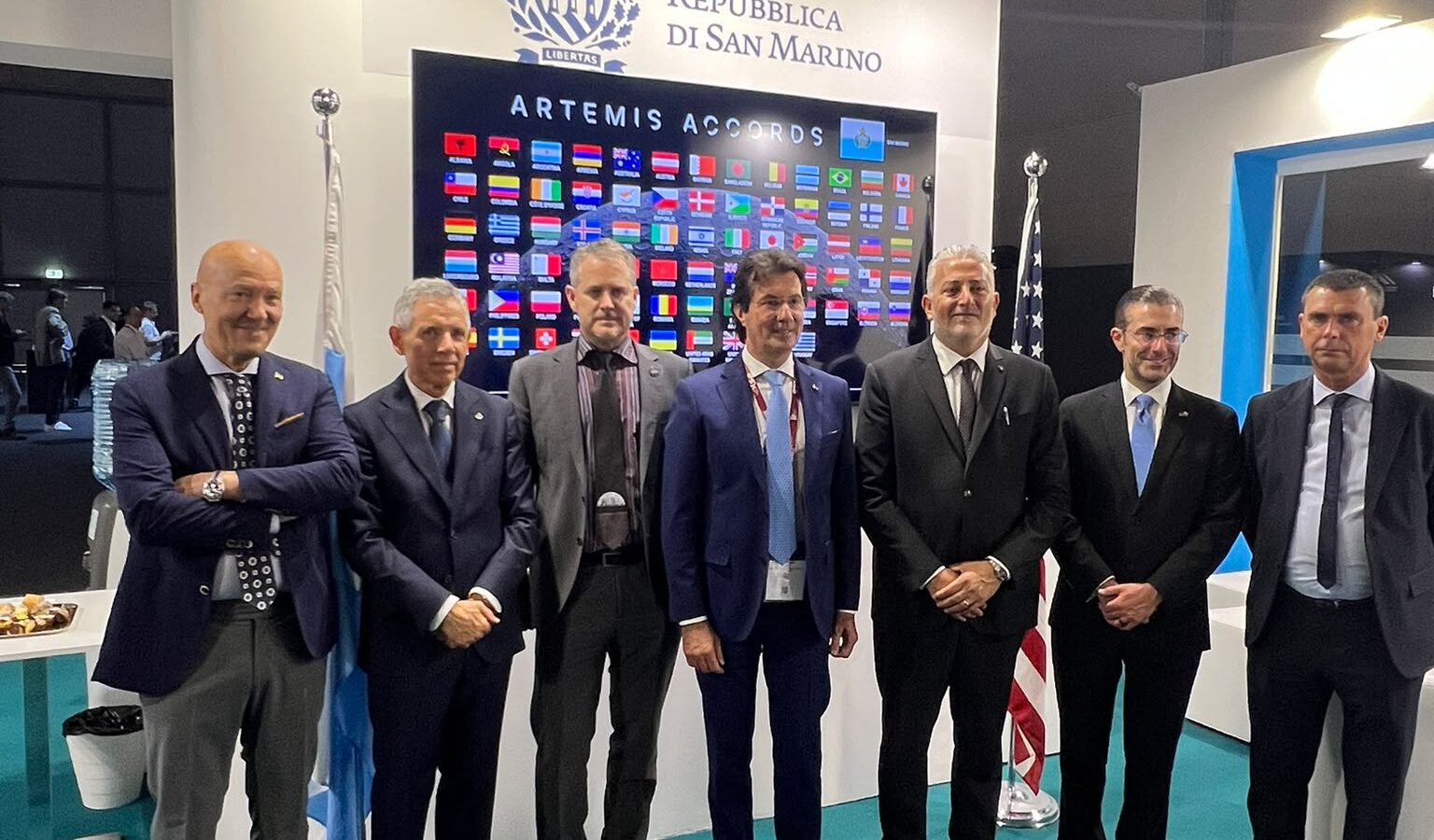
San Marino has signed the Artemis Accords, becoming the 74th country to join the international agreements on cooperation in space exploration. The signing took place at the close of the Republic’s participation in the Beyond Exploration Expo in Rimini: the accords were signed by the Secretary of State for Industry, Rossano Fabbri, in the presence of US Consul General Joe Tordella and NASA’s head for Europe, Gregory Mann.
For the Titano, taking part in the expo was also an opportunity to present its plans for entering the new space economy. At the heart of the project is a framework bill dedicated to the sector, presented during the BEX proceedings. The text, drafted by jurist Anna Masutti, aims to define authorization procedures, the registration of space objects, and rules on safety and civil liability. The measure remains a work in progress: a statement from the Secretariat of Industry lists the law’s entry into force among the next steps in the process.
“We are not looking for a token presence. We want to offer foreign investors a unique regulatory and operational framework, one capable of integrating our businesses into international aerospace value chains,” Fabbri said. According to the Secretary of State, the goal is to build a system in San Marino that links businesses, research, and investors.
Over the course of the three-day event, discussions involved representatives from space agencies and the industrial sector. Gregory Mann underlined the importance of transparency and the sharing of scientific data in exploration programs. Alexander Soucek, head of international relations at the European Space Agency, pointed to ESA as a possible point of reference for including San Marino in European research programs. At the San Marino stand, Fabbri also met with Italian Air Force astronaut Walter Villadei, with whom he discussed the sector’s prospects.
The talks also focused on what companies need to access this market: applied research, expertise, funding, and business contacts. The Secretary of State for Labor and Technological Innovation, Alessandro Bevitori, stressed the need for a stable link between universities and businesses. San Marino Enterprise, San Marino Innovation, and the Economic Development Agency outlined their respective tools for supporting companies and attracting investment. The University of San Marino presented its new regulations on university spin-offs.
The statement also identifies potential spillover effects in sectors already established in San Marino’s economy. Among the examples discussed at BEX are pharmaceutical research in zero-gravity conditions and the development of new materials for food packaging. A first working session under the framework agreement with the Emilia-Romagna Region also launched discussions on creating an aerospace district spanning the two territories.
Fabbri identified the initial priority as integrating San Marino’s technologies and services into the sector’s supply chains: “We’re keeping our feet firmly on the ground, and for now our initial priority remains getting our technologies, components, and the services created by the Republic’s businesses ‘off the ground.'”