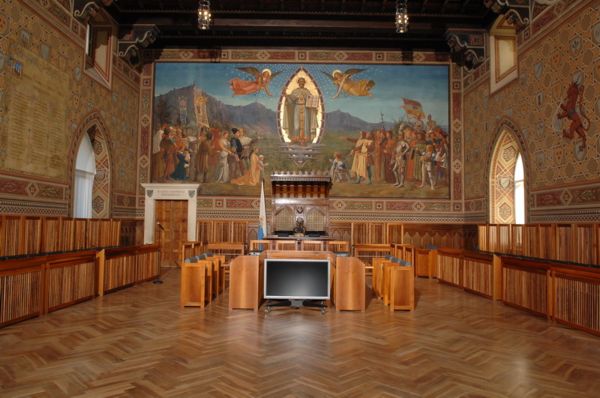
A reform that risks diminishing the role of the Grand and General Council (Consiglio Grande e Generale), narrowing the scope for individual councillors to intervene, and shifting a substantial share of legislative work from the floor of the Chamber to its committees. This was the common thread running through the opposition’s explanations of vote on the reform of Council procedure, approved at the end of debate by 36 votes in favour and 11 against.
For Nicola Renzi (RF), the main problem concerns precisely the role councillors will be able to play under the new rules. While acknowledging that some of the provisions originally envisaged were dropped during the review — including prior screening of amendments and a sharp reduction in speaking times — Repubblica Futura’s overall assessment remains negative. “I am truly sorry that this Chamber, and councillors themselves, want to relegate themselves ever further, through this set of rules, to a role that is not that of lawmaker and policy proposer,” Renzi said.
In his sights above all is the “sede redigente” — the drafting-committee procedure — set to become the ordinary method for examining legislation. According to Renzi, many councillors will risk being unable to intervene directly on the substance of articles and amendments, with consequences also for the quality of law-making. For RF, this choice ends up turning part of the Council’s membership into “mere button-pushers,” essentially called upon to vote on the final outcome of work carried out elsewhere.
Renzi also pressed the issue of transparency in committees, criticising the failure to introduce automatic public access to sessions and their broadcast. The consequence, he argued, affects not only the prerogatives of elected members but also citizens, who will have fewer opportunities to know the positions taken by their representatives during the detailed examination of the most sensitive issues.
Gaetano Troina (D-ML), for his part, focused on the practical consequences of the drafting-committee procedure. He cited as an example the very reform debate just concluded: discussion on the floor, he noted, made it possible to spot errors, correct provisions and amend proposals during the course of debate. Under the new mechanism, he observed, this kind of work on future ordinary legislation will be concentrated mainly within committees.
“We are losing a huge opportunity to do good work in terms of law-making,” Troina said. For D-ML, the issue also lies in the composition of the committees: since not all councillors are represented on them, people with specific professional expertise — potentially valuable in examining certain matters — could be left out of the discussion.
Troina did not deny that there is a problem with the Council’s timing, but he disputed the solution chosen. For D-ML, speeding up proceedings cannot mean cutting back opportunities for debate. Instead, the focus should be on improving organisation, encouraging more effective preliminary scrutiny of bills, and curbing the practice of tabling amendments at the last minute. Hence the group’s vote against the reform, with the exception of a handful of provisions on which broader agreement emerged during discussion.
Emanuele Santi (Rete) was equally critical, describing the text — even in its amended form compared with the initial version — as “a serious limitation on councillors’ right to speak and on their democratic rights.” Santi traced the path that led to the reform and accused the majority of stepping in after roughly a year and a half of work by the Committee for Institutional Reforms, thereby breaking, in his view, the balance that had been achieved there.
The Rete councillor called the project’s original framework a “real mess,” while acknowledging that during the process some of the most contested provisions were removed thanks in part to the openness shown by figures within the majority. The changes, however, are not enough to alter his overall judgment of the measure.
For Santi too, the central issue remains the drafting-committee procedure. The risk, he argued, is that substantive work on legislation will be entrusted to the fifteen committee members, leaving other councillors able to take part in the general debate and the final vote, but not on the same level of engagement with the substance of the articles.
Rete is equally firmly opposed to the “guillotine” on amendments, which Santi said could have a particularly significant impact during examination of the budget law. Amendments, he argued, are not merely a technical tool but also a means by which the opposition puts forward proposals and seeks to push the Government and majority toward compromise.
“You are forgetting that this Chamber exists to do politics. We are here to do politics, to seek compromise and to put forward proposals,” Santi concluded, announcing Rete’s firm vote against the reform — a stance that fits within the broader opposition rejection of the reform, which was ultimately approved by the Council with 36 votes in favour and 11 against.