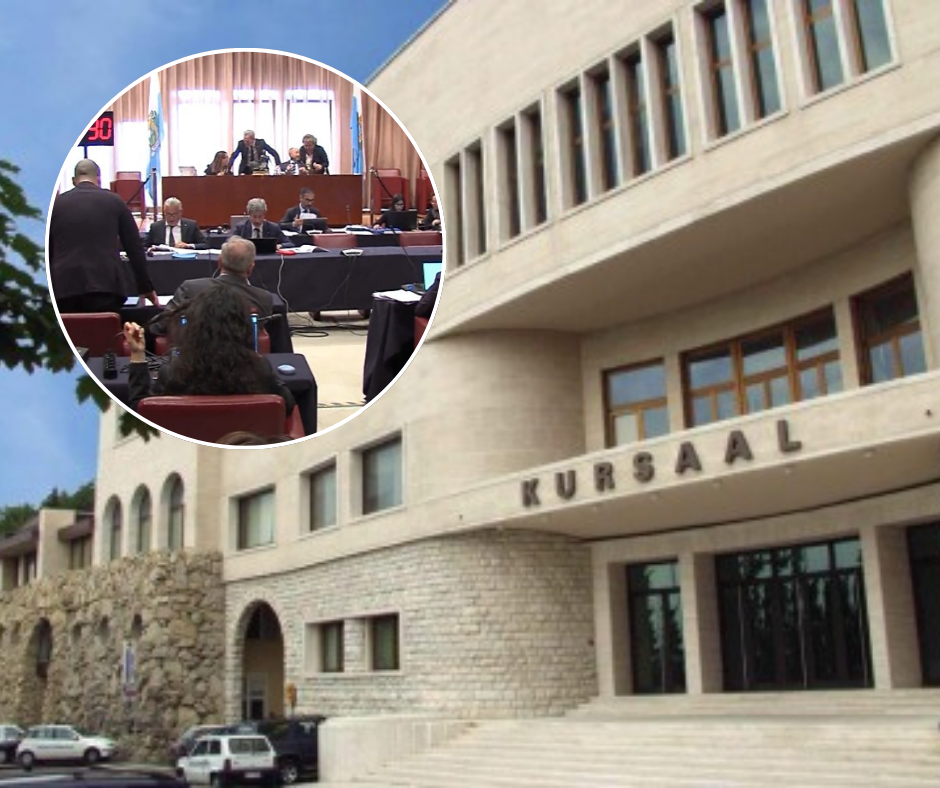
From the association agreement with the European Union to the future of San Marino RTV, by way of a leadership reshuffle at the top of the security corps, healthcare, the new hospital, cannabis and fibromyalgia. But the debate was also forcefully marked by the issue of hate messages against Muslims and Palestinians circulating online. Monday, September 22, brought a packed morning of discussion in the joint Commission, with both majority and opposition raising a long list of issues and the Government called upon to respond.
One of the most sensitive topics was raised by Matteo Zeppa (Rete). The councillor brought directly to the Commission’s attention the content of a post targeting people of the Muslim faith, reading out some passages and warning of the risk that such messages could fuel hostility and offer a distorted portrayal of events. For Zeppa, the issue also concerns the increasingly delicate line between freedom of opinion and incitement to racial or religious hatred. The movement’s position is unequivocal: “Rete completely dissociates itself from this kind of message.”
Guerrino Zanotti (Libera) associated himself with this stance as well. Foreign Secretary Luca Beccari then intervened on the matter, describing the messages against Palestinians as reflecting “a way of behaving and a culture of hatred that, frankly, are not part of who we are,” and urging that such incidents not be met with silence, invoking San Marino’s tradition of solidarity and hospitality. Gerardo Giovagnoli (PSD) also weighed in on the point: press freedom, he argued, is “almost sacred,” but it must go hand in hand with responsibility and ethics.
Another hot topic was the association agreement with the EU, with the signing set for October 19. Emanuele Santi (Rete), Nicola Renzi and Antonella Mularoni (RF) called for a clear roadmap on the transposition of the EU acquis, the sharing of already-drafted texts, and the involvement of professional bodies and intermediary organizations.
Beccari expressed openness to dialogue, proposing a discussion within the Commission for institutional reforms and a joint session of Commissions I and II. The secretary explained that several texts are already prepared or in the works, covering areas including the environment, residency, labor, competition, consumer protection, digital services, product safety, state aid and workplace safety. Legislative activity is expected to begin before the end of the year.
Attention then turned to San Marino RTV. The opposition pressed for clarity on the future of director Roberto Sergio and, more broadly, on the broadcaster’s industrial plan. Beccari noted that, under the agreements with Rai, the appointment of the director falls to the Italian side. Sergio can technically remain in place until his mandate naturally expires, and at present there have been no official talks about a change at the top.
Also dominating the discussion was the simultaneous leadership turnover at the helm of the three police corps. Fabio Righi (D-ML) asked that the selection of the new commanders be accompanied by a broader discussion on the organization of the security forces. For the Gendarmerie, the Government intends to continue its collaboration with the Carabinieri and is looking at an external figure with international experience in investigative work, counter-terrorism and anti-mafia operations.
On the healthcare front, Matteo Casali (RF) scrutinized the choices made in recent years and returned to the new hospital project, wryly dubbing it “the Loch Ness hospital — the one that appears, disappears, and then reappears.” According to Casali, the healthcare model must be decided first, before designing the structure itself.
Health Secretary Massimo Andrea Ugolini postponed detailed discussion to the end-of-month hearing with the ISS Executive Committee, but assured that work is underway on waiting lists, community-based medicine and services for the most vulnerable. On the future hospital, he drew a firm line: currently guaranteed services must remain public. “We are not willing to privatize any of them,” he stated.
Cannabis also had its moment, with Zanotti painting a picture of a sector still struggling: of the seven companies authorized by the end of 2025, only one is actually operational. Ugolini reported that the technical working group provided for by law has already been convened and that contacts with Italy and Europe are continuing.
Gaetano Troina (D-ML), meanwhile, returned to the popular-initiative bill on fibromyalgia, asking that it not be left languishing. Ugolini assured that the Government stands ready to address it as soon as it reaches Commission IV for examination.
Finally, Righi requested clarification on relations between San Marino and the Chinese group BYD, including any potential agreements and plans to test batteries and charging stations, also raising the question of possible geopolitical and security implications.
The morning ultimately found a point of unity: the motion to strengthen parliamentary relations with small European states, beginning with official friendship ties with Luxembourg and Cyprus, was approved unanimously.