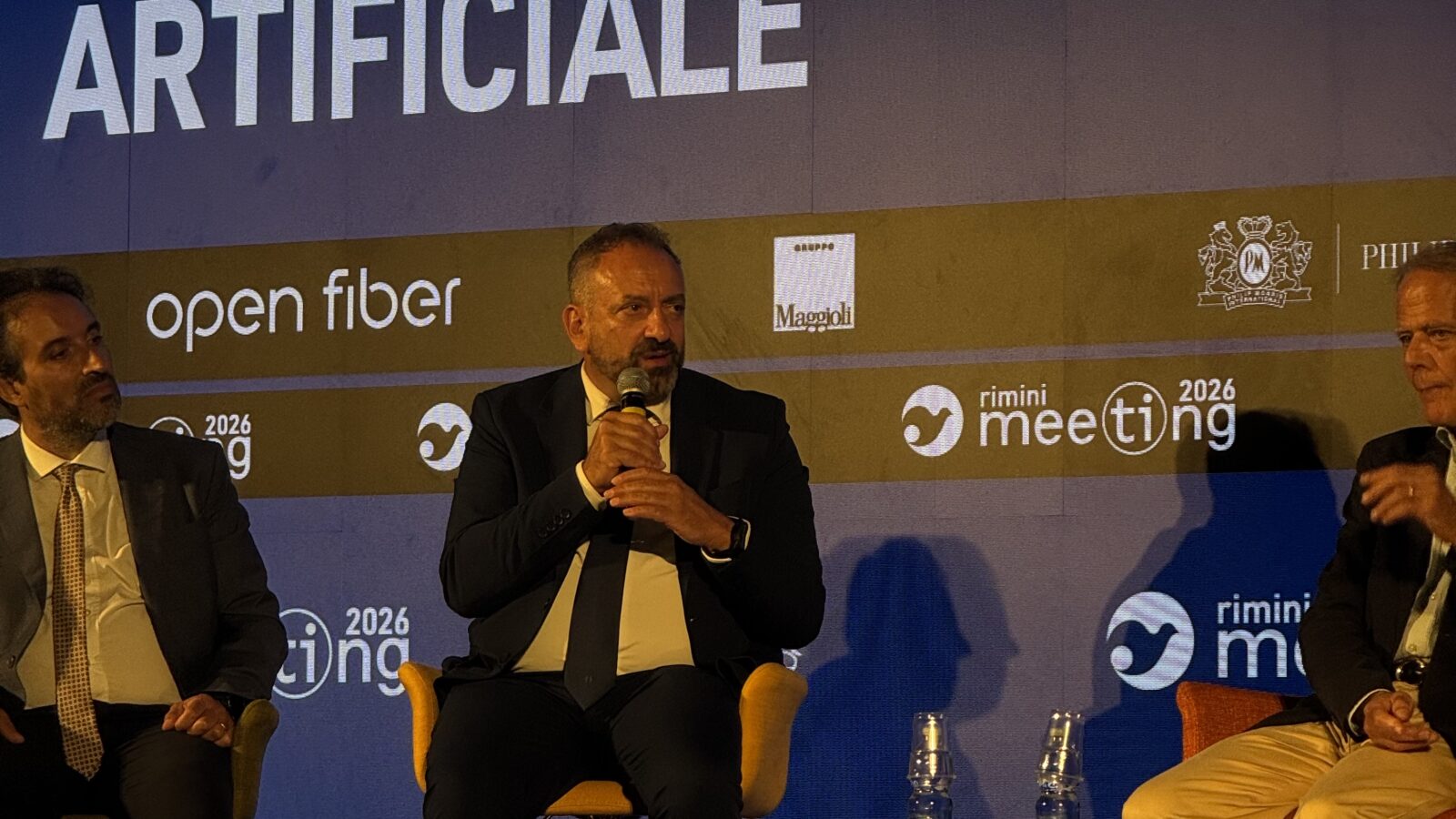
San Marino wants to play an active role in Europe’s challenge on artificial intelligence, championing shared rules, international cooperation and the protection of the human dimension. This was the message delivered by Foreign Secretary Luca Beccari at the Meeting for Friendship among Peoples in Rimini, where he spoke on the panel “Europe’s competitiveness in the age of artificial intelligence.”
Moderated by Meeting Foundation president Bernhard Scholz, the discussion also featured Francesco Billari, rector of Bocconi University in Milan; Enzo Moavero Milanesi, professor of European Union law at Luiss-Guido Carli; Uljan Sharka, CEO of Domyn; European Parliament Vice-President Pina Picierno; and Massimiliano Salini, vice-president of the European People’s Party.
The debate focused on artificial intelligence, competitiveness, market speed and the interconnection of economies, while also examining the social and human consequences that come with technological development.
A statement from the Foreign Secretariat stressed that the challenge is not only about keeping legislation in step with fast-moving technology, but also about preventing the relationship between man and machine from being turned on its head: technology must remain in the service of humanity, rather than being allowed to define what humanity itself is.
Beccari also referenced the recent visit to San Marino by Pope Leo XIV and the address delivered on that occasion by the Captains Regent Alice Mina and Vladimiro Selva, in which it was noted that progress cannot be measured solely by the capacity to innovate and the pace of scientific development, but must also encompass human dignity, freedom of conscience, responsibility, solidarity and the pursuit of the common good.
The future of relations between San Marino and the European Union also entered directly into the discussion. The Republic, the Secretariat noted, intends to be an active participant in the international debate on regulating artificial intelligence.
In this light, the Association Agreement with the European Union – and the resulting adoption of the EU’s digital framework – takes on particular significance. For San Marino, it means choosing to become a full part of a European space governed by shared rules, avoiding the risk of being left on the margins of the technological and regulatory processes now underway.
“We live in an era when there is a growing awareness that it is no longer sustainable to think in isolation,” Beccari said. “We need to build synergies between countries, and for San Marino these take shape above all in our relations with Italy, which in turn extend into a broader European context.”
It is, therefore, a path that links innovation with European integration – one in which San Marino intends to find its own place in the digital transformation without ever losing sight of the centrality of the human person.