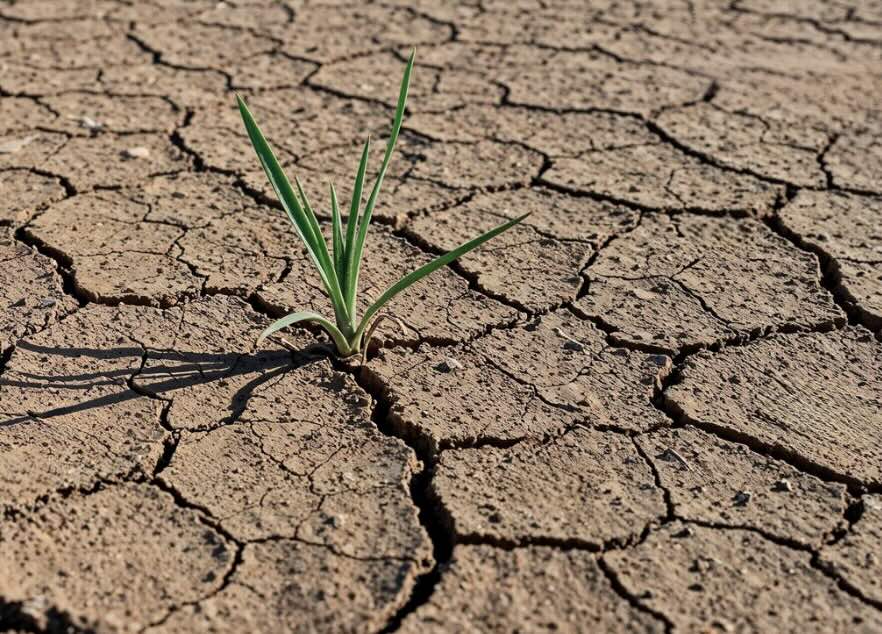
The Republic is in a water emergency. Yet it depends on Romagna for the water it drinks, and even entrusts Romagna with treating the wastewater it discharges — water returned to a river and never reused. Cyprus, Malta and Emilia show that reuse works even on a small scale. Objections exist, but they can all be solved. The real risk is the usual one: moving too late.
Since 10 August, San Marino has been in a state of water emergency. With Ordinance No. 1 of 2026, the AASS (the state water and electricity authority) put in writing what recent months had already suggested: between scarce rainfall, prolonged heat and the restrictions on withdrawals from the Marecchia imposed by ARPAE, Emilia-Romagna’s environmental protection agency, water availability has dropped to the point where the supply for human consumption must be legally protected, with absolute priority given to drinking water. It is a vulnerability that has been known for years, and never truly addressed.
An autonomy that doesn’t exist
The problem is not this summer’s heat, but the fact that San Marino largely does not have its own water. The Republic covers its needs by drawing more than half from the Marecchia river, captured at the Torello station; it buys roughly a quarter from Romagna Acque, the company that manages the Ridracoli dam; the rest comes from the Hera network. Sources within its own territory, on their own, cover only a minority of demand. The result, by the AASS’s own admission, is “a cocktail” whose proportions change almost daily, so variable that it proves corrosive to the pipes, which have been replaced section by section for years. Every day the Republic consumes about 10,000 cubic metres of water — ten million litres — almost all of it coming from outside or from a river that flows through Italian territory.
Even the infrastructure that symbolises the country’s autonomy is only half its own. The Torello reservoir, the Republic’s largest catchment basin, is not located in San Marino but in the Italian municipality of San Leo, and is fed by the Marecchia. The expansion of that basin — the project currently under discussion — stems from an agreement with San Leo and a convention signed with the Region of Emilia-Romagna. In practice, to get more water San Marino is planning to enlarge a lake that isn’t even on its own territory, fed by a river whose withdrawals are authorised — or denied — by an Italian agency. The same agency that, in August, restricted those very withdrawals.
Even the wastewater goes to Romagna
There is then a second, less discussed chapter that closes the circle of dependence: San Marino not only buys most of the water it drinks, but also entrusts Romagna with treating the water it discharges. The Republic’s wastewater is collected and treated in Italy, at the Santa Giustina plant in Rimini, run by Hera, which processes together the wastewater of Rimini, around ten Romagna municipalities and “the State of San Marino”, for a load that in summer reaches 560,000 population equivalent. This is not hidden information: it is documented both in the technical files of the Municipality of Rimini and by the Hera Group itself, which still lists Santa Giustina today as the destination for San Marino’s discharges as well. Once treated, that water is returned to the environment, flowing back toward the Marecchia and the sea.
The resulting cycle is paradoxical. Water enters San Marino from the Marecchia, is used, ends up in the sewer system, flows downstream into Romagna to be treated, and is finally discharged once again into the very same river it came from. At every step, a decision that is not the Republic’s to make. And above all, every cubic metre of treated wastewater — water already processed and ready for use — is thrown away instead of being reused.
The approach so far: only chasing the problem
Faced with all this, the institutions’ response has so far been of only one kind: increase supply. More catchment capacity, with the Torello expansion; more purchases from outside; maintenance work on the distribution network. Sensible measures, but all focused on the open-tap side of the equation, and almost all launched under the pressure of emergency. On the opposite side — the waste of already-treated water that simply flows away — nothing has been done. It is no surprise that the opposition has long pressed the issue: as far back as 2023, Repubblica Futura was demanding answers about feasibility studies and a “Water Management and Protection Plan” that never truly materialised. A subject that has been open for years, and remains unresolved.
Reuse: what the small states teach
And yet a structural answer does exist, and there is only one: reusing treated wastewater. In concrete terms, this means taking the water that today ends up in a river and refining it further, with an additional treatment stage, until it is suitable for irrigation or storage. This is not an exotic technology, and above all it is a lesson that comes from small Mediterranean states — far more useful models for Titano than the large countries usually cited.
Cyprus, which has the highest water exploitation index in Europe, reuses about 90% of its treated wastewater and sells it to farmers at subsidised rates, as low as €0.07 per cubic metre. Malta, tiny as it is, has built three plants producing so-called “new water“, continuously distributed to farmers. The Spanish region of Murcia reuses almost all of its treated water, linking treatment plants directly to irrigation networks. For reuse, in other words, small scale is not an obstacle — it’s an advantage.
Even Italy, a late starter, has picked up the pace. At Mancasale, in Emilia-Romagna, a refinement facility costing €2.5 million (nearly €1.5 million covered by the Region), with an operating cost of just €0.037 per cubic metre, returns up to 7 million cubic metres a year to agriculture — a figure set to double soon. In Puglia, hit hard by the water crisis, the San Severo plant supplies roughly 4 million cubic metres a year to agriculture in the Capitanata area, and the region aims to go from nine active reuse plants to more than forty. Europe is pushing in the same direction, with Regulation 2020/741 on water reuse for irrigation, in force since 2023, and Directive 2024/3019 on wastewater, both openly promoting circularity. For San Marino, which through the Association Agreement is moving closer to the EU legal framework, adopting those standards today means not having to chase them tomorrow.
The objections — and why they don’t stop the case
Three real issues remain, and they should not be swept aside. None of them, however, is a dead end: they can be solved, and they only get worse if we stand still.
The first, and most serious, is the geography of treatment: as noted, San Marino’s wastewater is not currently treated within its own territory, but in Rimini. Even so, a quick route already exists: negotiating the return of shares of refined water from the plants that already treat the Republic’s wastewater, as part of the agreements with Romagna and the broader European path. Alongside this, a more ambitious option should be put on the agenda right away: building, over time, domestic refinement and storage capacity. In any case, the only option that no longer holds up is the current one: continuing to discharge already-treated water without recovering a single drop.
The second issue is cost, which deserves to be stated plainly. The refinement facility alone costs about as much as a roundabout, but the network that carries the water where it’s needed costs more. Even so, we are talking about a few million euros — the scale of an ordinary public works project — and there are levers that have worked elsewhere: at Mancasale, the Region covered more than half of the investment, and for San Marino the association process opens access to European funding instruments for climate adaptation and the circular economy. Those funds, however, have windows that eventually close, and construction costs only keep rising: every year of delay is a costlier year.
The third issue, demand, resolves itself as soon as one stops copying others. San Marino doesn’t have thousands of thirsty hectares like Puglia, but it doesn’t need them. For a micro-state with no rivers of its own and no deep aquifers, the most valuable use of refined water is not irrigation, but storage. An expanded Torello, filled in winter by rainfall and in summer by recovered water, would become the strategic reserve the country currently lacks: a buffer against drought, for firefighting and for public green spaces. For the Republic, reuse would not be about irrigation but about insurance. And without it, every dry summer will bring the emergency back, with the reserve still missing.
Not whether, but when
At this point the questions no longer concern whether to adopt reuse, but how: where to build the refinement facility and under what agreements, how to finance it within the European framework, how to truly integrate it with Torello rather than treating it as a stand-alone project. These are questions of implementation, not principle, and they must be asked now, because the window to answer them calmly is closing.
On water, after all, San Marino has so far only moved to catch up: it expanded catchment capacity when the river dropped, it declared an emergency when ARPAE cut withdrawals, and it is now asking what to do when doing it is already difficult. This is the most expensive way to manage a resource: waiting for it to become a problem before dealing with it. And the climate no longer allows for this luxury: summers will be longer and drier, available drinking water ever scarcer, and every year spent studying the issue will mean one less option on the table.
Preventing costs less than rebuilding after an emergency, and infinitely less than being left without water during a drought. The Republic today has a water resource that is already its own, and it throws it into a river every single day. The choice ahead is a simple one: recover it now, while costs are contained and margins are wide, or later, when urgency will once again be the one making the decision. San Marino knows all too well what it means to arrive too late, when there is nothing concrete left to do. On water, it cannot afford to make that mistake again.