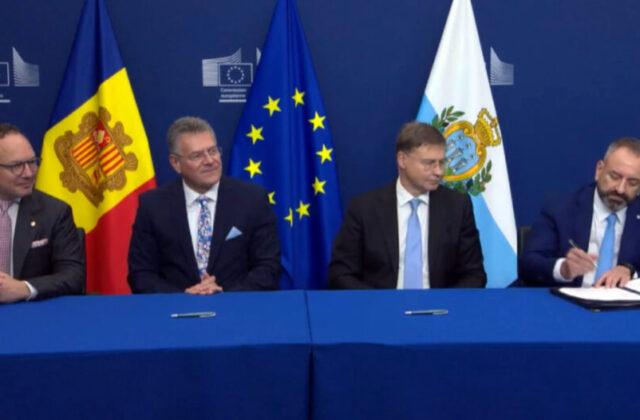
The Grand and General Council (Consiglio Grande e Generale) opened debate on Monday, November 23, on the ratification of the association agreement between San Marino and the European Union. The agreement, signed in Brussels on October 19, reaches the chamber after negotiations spanning several legislatures.
San Marino’s approval paves the way for provisional application. To complete the process, all 27 EU member states will need to give their consent.
“The association agreement is the passport to enter the single market, which already has its own rules that we will need to follow.” Foreign Affairs Secretary of State Luca Beccari began with this point to explain what will change.
San Marino companies will be able to sell products, offer services, bid for public contracts and open branches under the same conditions as their European competitors. For those wishing to study or work in the EU, new opportunities for relocation will open up, with protections guaranteed in the sectors covered by the agreement.
Beccari also sees room to resolve certain issues with Italy that have proven difficult to address through bilateral agreements. On the question of sovereignty, the secretary noted that San Marino retains its independence and that adjustments have been made to reflect the Republic’s unique characteristics.
Giuseppe Maria Morganti (Libera) pointed out that the association agreement has economic and social content and does not involve San Marino’s political participation in the EU. The real change, he said, lies in the ability of citizens and companies to assert their rights before the Court of Justice of the European Union. Silvia Cecchetti (PSD) brought the discussion down to everyday life.
“Think of the conditions for getting a mortgage to buy a home, for example, or those for a business seeking financing.” For the councilor, the work of adapting San Marino’s laws should start from the European rules developed since 2023 and continue as those rules evolve.
Repubblica Futura will vote in favor, announced Nicola Renzi, who called for immediate action on banking. The transition period can last up to 15 years, but according to Renzi, decisions must be made now on how the sector should function in five years’ time, how to protect jobs and how to attract new operators.
Luca Gasperoni (PDCS) recalled that San Marino’s banks have already adapted to many European rules as a result of the monetary agreement. Access to the single market for financial services will depend on meeting the required conditions. For Gasperoni, what is needed is adequate capital, rigorous controls and closer cooperation with Italian and European authorities.
Domani Motus Liberi, however, challenged the approach taken by the government and the majority. Gaetano Troina recalled that his group had requested that the ratification be discussed alongside the referendum proposal and the method for introducing European rules. That request was rejected.
“If there was studying to be done, it should have been done before getting here.” Troina asked which offices would oversee the work, how staff had been trained and how the changes would be explained, sector by sector.
Maria Luisa Berti (AR) asked the State Congress for a plan with priorities, deadlines, responsibilities and resources, so that the Council would know in advance which laws it will need to discuss.
“The public administration is ready.” Secretary Andrea Belluzzi responded that government offices had followed the negotiations closely, that the first draft laws are already being prepared, and that training has already begun with the support of the University and the Institute of Law.
According to Belluzzi, joint bodies with the EU will also allow San Marino to flag difficulties and priorities while European rules are still being drafted.
Aida Selva (PDCS) emphasized the opportunity for San Marino businesses to compete on equal terms with their European counterparts and thanked those who had followed the negotiations across different legislatures. Giovanni Francesco Ugolini (PDCS) acknowledged the work of previous governments while crediting Beccari and the current majority with achieving one of the goals set out in the government’s program.
Secretary Rossano Fabbri highlighted Europe’s importance for exporters. “Ninety percent of our exports go to the European Union, and of that 90 percent, 90 percent goes to Italy alone.”
For Fabbri, it will be small businesses, professionals and the self-employed who need the most support in adapting to the new rules.