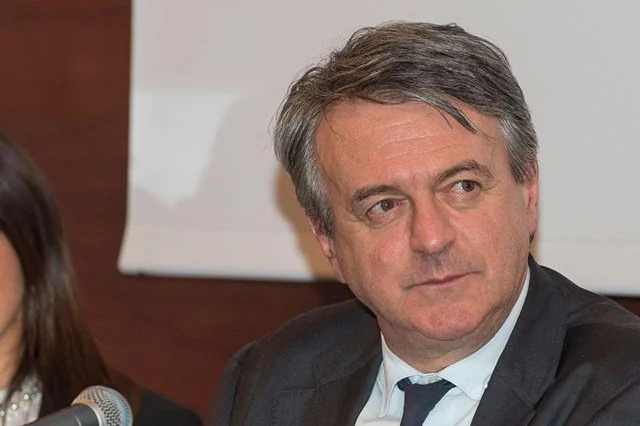
In item 7 of the Grand and General Council’s (Consiglio Grande e Generale) agenda, concerning the ratification of the Association Agreement with the European Union and the agreement amending the Monetary Convention, Giuseppe Maria Morganti (Libera) highlighted one of the agreement’s key innovations: the ability for San Marino citizens and businesses to assert their recognized rights before European bodies.
The councillor recalled that he had supported full EU membership and stressed that it will now be up to the public administration, above all, to follow through on the commitments made.
Below is his speech in full.
«We can only be glad about the historic moment the Republic of San Marino has reached with the signing of the Association Agreement. This is an agreement that will need to be managed carefully and that demands a major commitment from the State — particularly from the public administration — but also from the whole country, in order to establish new standards in employment, labour and, probably, social matters as well.
As the Secretary said, there is finally a fundamental issue being addressed for San Marino’s citizens: that of being recognized and of having a relationship of reciprocity with the rest of our continent.
Europe is our continent of reference. What was yesterday’s Europe? It was the Europe born in Ventotene, which set out the fundamental principles of civil, political and social coexistence for citizens and guaranteed roughly sixty years of peace across a vast territory scarred by two world wars, with tens of millions of dead.
The central point was peace. It was a Europe bound to the principles of democracy and collective security, one that said a clear and resounding no to every form of nationalism and totalitarianism.
Nationalism, unfortunately, is resurfacing today even in some European countries. Totalitarianism, thankfully, is not — not yet — but we are getting close, because nationalism very often paves the way for totalitarianism.
Freedom, including individual freedom, was one of the founding principles of the Ventotene Manifesto. And there was another great objective: that of European welfare. European citizens could count on a relationship with public institutions that protected them in many respects, particularly in education and healthcare.
That was yesterday’s Europe. When we were somewhat younger, it drew us in and filled us with enthusiasm, because those great principles were being proclaimed and pursued.
Today’s Europe is, admittedly, a little more problematic. It continues to engage seriously with environmental issues — at times, perhaps, pushing them too far. On civil rights, I would say it remains a great Europe.
After Maastricht, however, it probably lost sight somewhat of the great goal of European welfare, and today it seems to have forgotten another great objective: peace. It is therefore a far more troubled reality than the one that once filled us with enthusiasm.
Nevertheless, you know my view — our view. We pushed for the referendum, and we supported, then as now, the possibility of full membership. We believe that countries like the Republic of San Marino, which strives every day to uphold the fundamental principles I have just described, could make an important contribution to political debate within Europe as well.
That will not happen here. The Agreement we are about to sign is social and economic in nature and does not provide for political participation. It is nonetheless highly significant, because it gives the Republic of San Marino, its citizens and its businesses the chance to be recognized.
You might ask: “But who will even notice this microstate in a market of hundreds of millions of people and 50 million businesses?”
If they don’t notice, there is the European Court. We will bring our case to the Court and assert our rights. This is an essential element, and we must thank those who conducted the negotiations, because on this point they set in motion an extremely important mechanism, one that will finally allow the interests of businesses and citizens to be fully protected.
Yesterday’s Europe, and indeed today’s, has almost been seen as a kind of myth. The transparency rules introduced in the single market and in relations among Europeans set an example that the Republic of San Marino had, gradually, to live up to.
Think back to the notorious 1990s here in San Marino. Whenever people thought of Europe, they thought above all of transparency policies. Those who were genuinely pro-European wanted, first and foremost, for the Republic of San Marino to become transparent. It was not, and it remained so until the end of the first decade of the 2000s, when mechanisms were finally set in motion that put us on that path.
We got there on our own, partly out of necessity and partly by choice, because a good deal of courage was shown. The Republic paid a very high price. If we have public debt today, it is because of the policies we finally adopted in the banking and financial sector.
We managed to put right a system that was, forgive the term, perverse. I was always opposed to it.
The idea behind Europe was that the Republic of San Marino could integrate with these systems and give its economy — and not only its economy — that transparency and that capacity to interact honestly with other states, let’s be candid about it. The Republic has walked that path, and at great sacrifice too.
The results we achieved through autonomous, home-grown policies, let’s call them that, probably worked in our favour on the road toward the Association Agreement. We paid a heavy price, and we risked continuing to pay it, in terms of incompatibility and difficulty engaging with European economic structures, had we not taken this path.
Today we are also discussing the ratification of the amendment to the Monetary Convention. Think about the Monetary Convention and ask yourselves whether it is an agreement that favours the Republic of San Marino or penalizes it.
It certainly does not favour us. I won’t go so far as to say it penalizes us. It is a means of integrating into a system and managing the euro, but the constraints it introduces have not always had positive effects on our system. Still, it has helped us cross the ford.
I recall an informal meeting with a former President of the European Commission, who told us: “For the Republic of San Marino, life is easy enough. All you need to do is mint a few extra coins and print a few stamps.” That was the regard in which we were held in the European world.
I don’t believe that is still the case today. I truly thank the Secretaries of State for Foreign Affairs who have held office over these years. Little by little, you have helped us understand matters that are quite complex, such as those contained in the 28 annexes, and at the same time you have gradually, and with great patience, opened up a path along which the Republic of San Marino can now glimpse its future.
It is a future of change, even compared to the conditions we have today. Until yesterday, we were already on a path, but without benefiting from favourable conditions.
Today, with the signing of the Agreement, these conditions are finally set down in black and white and can be put into practice. It will be up to the Republic of San Marino — the State, the public administration in particular, as well as businesses and citizens — to know how to seize these opportunities and make the best use of them. I hope they will serve to build a better life, including in terms of the advancement of conscience and culture.
Thank you. Thank you again for reaching this important milestone».