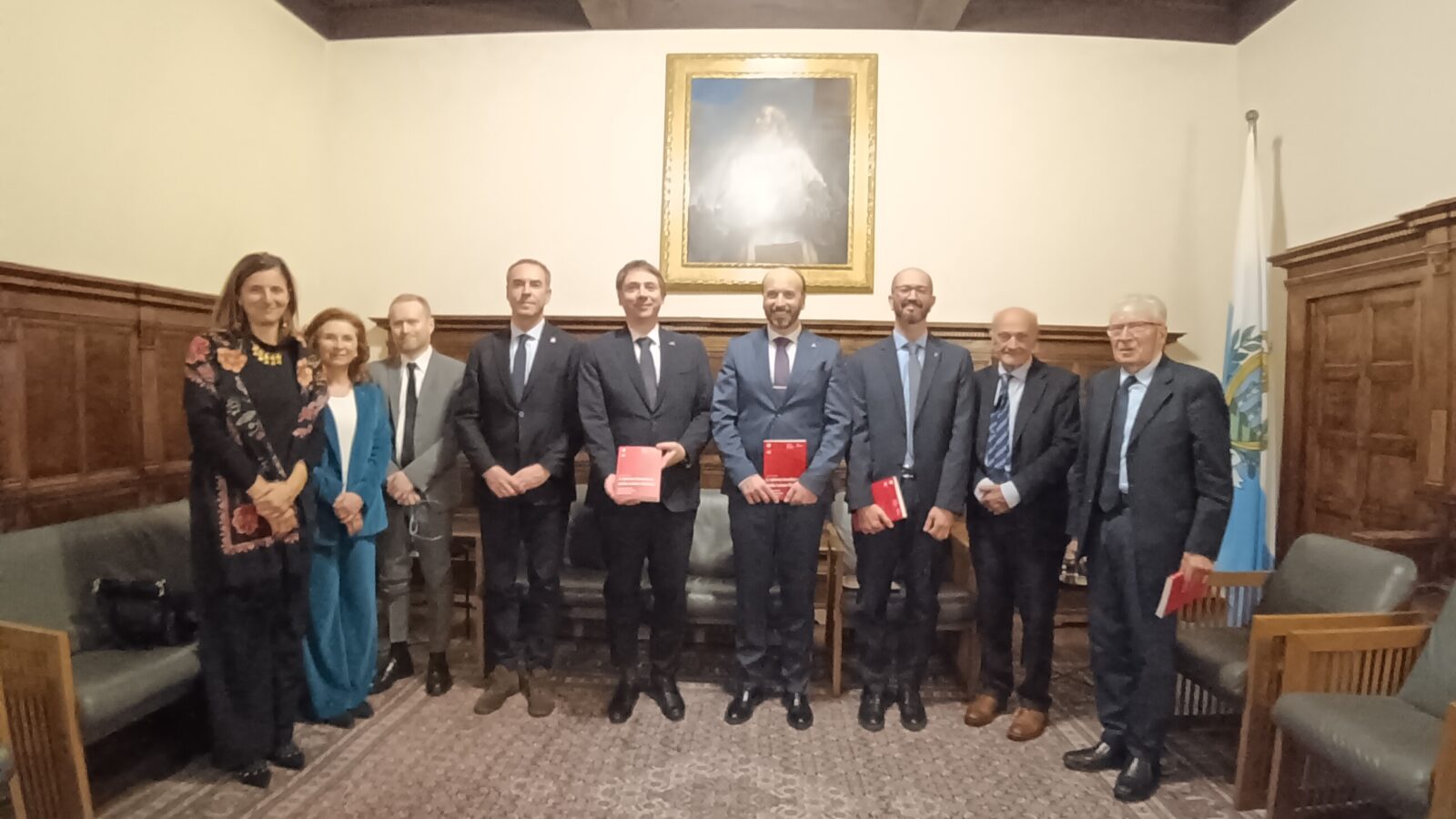
The fighting that took place on San Marino’s territory in the summer of 1944 is at the heart of “L’ultimo bastione della Linea Gotica” (“The Last Bastion of the Gothic Line”), a book by Andrea Santangelo presented on 17 November at Palazzo Pubblico to the Captains Regent Gerardo Giovagnoli and William Giardi. The 189-page volume is the 46th in the series of Quaderni published by the Centro Sammarinese di Studi Storici at the University of San Marino.
“The reconstruction of Allied military operations, an analysis of German forces, and a study of the fighting on San Marino’s territory” — these are the three main strands of the research, as outlined by the university, alongside an examination of tactics, maps and weapons. The book traces the events of those months, when the German army was in retreat and Allied forces were advancing northward through the Italian peninsula.
Santangelo describes the Gothic Line as “one of the most brutal and tragic theatres of operations” of the Second World War. During that phase, the university’s statement notes, “the small territory of San Marino suddenly found itself at the centre of a military, social and political situation of extraordinary complexity.”
Part of the book is devoted to the German defences. The author describes troops that were “understrength and with morale” shaken “by the fighting of the preceding days.” Nonetheless, these units managed to organize “a series of defensive positions in a short time” and to contest, “foot by foot, the republic’s territory against forces numerically and materially superior” — the Allied forces.
In the end, Santangelo writes, “tactical skill and adaptability could not make up for the overall strategic inferiority.” The author frames the fighting on Mount Titano as an “emblematic episode of the final phase of the Italian campaign, a war of attrition fought metre by metre, in which even the most effective actions ultimately delayed, but could not prevent, the conflict’s final outcome.”
The audience at Palazzo Pubblico was attended, alongside the author, by the Secretary of State for Education and Culture Teodoro Lonfernini and representatives of the University of San Marino’s Department of Historical and Legal Studies: Stefano Pivato, Luca Gorgolini, Valentina Rossi, Patrizia Di Luca and Ivo Biagianti.