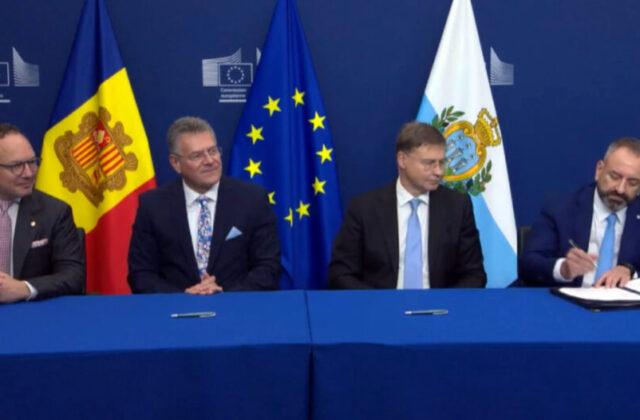
The agreement with the European Union has been signed, but political debate in San Marino is far from settled.
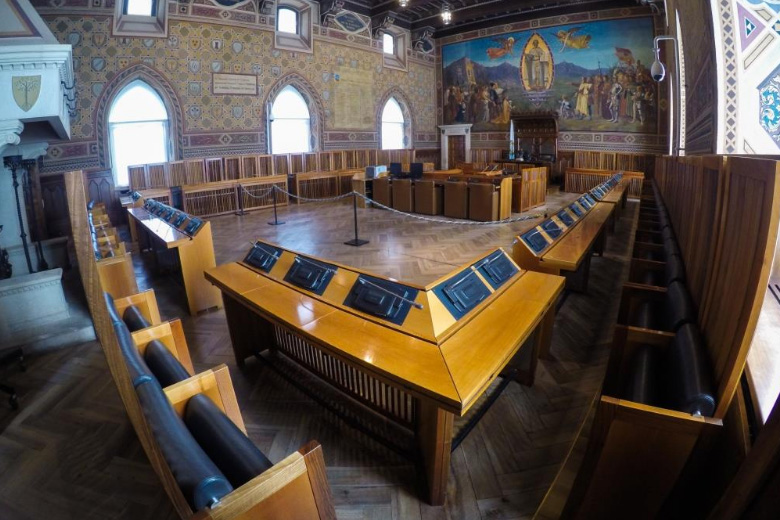
A referendum, the future of the banking sector, economic reforms and the protection of sovereignty were all at the centre of Monday 9 November’s session of the Foreign Affairs Committee. The discussion revealed sharply differing positions, particularly over the timing and the choices needed to prepare the country for entry into the European single market.
Defending the path taken was Foreign Affairs Secretary of State Luca Beccari, who reviewed more than a decade of negotiations, recalling that San Marino’s old economic model was no longer sustainable.
Remaining isolated, according to the Secretary, would have meant progressively shrinking the country’s growth prospects. Hence the need to build a stable relationship with Brussels capable of offering new opportunities to citizens and businesses. “This is the political meaning of the agreement: seeking a right of equivalence for Sammarinese citizens and businesses with their European counterparts.”
But the signature alone is not enough. Ilaria Bacciocchi (PSD) called for clarity on what kind of economy San Marino wants to build in the coming years.
On the table are VAT reform, the competitiveness of the banking sector and the functioning of public administration — not to mention the consequences of any future growth: more businesses mean more workers, and therefore greater demand for housing, transport and healthcare services.
Dalibor Riccardi (Libera) defended the European choice, dismissing fears of a loss of sovereignty. San Marino, he noted, will not become an EU member state and will retain its own identity.
Matteo Zeppa (Rete) instead saw the agreement as an opportunity to move past old privileges and political habits. For Francesco Mussoni (PDCS), a new phase is beginning in which the institutions will have to learn to deal directly with Brussels without losing the special relationship with Rome.
The debate grew heated especially over the referendum issue. Fabio Righi (D-ML) criticised the absence of a national economic development plan that should have accompanied the negotiations. Before moving forward, the committee member argued, it is necessary to clarify costs, resources and the sectors worth investing in. Hence his call to directly involve the population, following an adequate information campaign.
Lorenzo Bugli (PDCS) pushed back on this position, noting that the agreement had featured in the programmes of the governing majorities voted in by the electorate over the last four legislatures. For Bugli, the time has come to focus on economic opportunities, starting with the insurance sector.
Nicola Renzi (RF) also acknowledged the need for greater citizen involvement, while still supporting the deal. His main concern, however, lies with the banks.
Waiting fifteen years to complete financial integration would be a mistake, he warned, calling for the market to be opened more quickly to European operators in order to guarantee better conditions for families and businesses.
Matteo Rossi (PSD) also called for faster action, recalling past mistakes — notably when San Marino turned down a cooperation agreement with Italy out of fear of losing sovereignty. That choice, according to Rossi, contributed to the difficulties later faced by the financial system.
Alice Mina (PDCS) and Maria Luisa Berti (AR) both stressed the need to translate the agreement into concrete benefits.
Sara Conti (RF) called instead for making better use of the skills already present within the public administration before seeking new staff. Manuel Ciavatta (PDCS) listed insurance and rules on property purchases by non-residents among the priorities, in order to protect San Marino’s housing market.
Beccari rejected accusations that government offices were unprepared, insisting that work to implement the agreement began years ago. He nonetheless acknowledged there could be difficulties in the initial phase. As for the banks, he reiterated that Brussels would never have accepted integration without common rules and an adequate supervisory system.
The Committee also addressed the revision of the Monetary Convention, signed alongside the association agreement. The amendment will serve to coordinate the two agreements, gradually transferring banking and financial rules into the new accord while keeping provisions relating to the euro within the Convention. Beccari assured members that safeguards are in place to prevent problems should the association agreement ever be suspended.
Political debate then turned to the Banca Cis case, following the recent first-instance ruling that resulted in eight convictions. Zeppa criticised the silence of certain political forces, revisiting responsibilities from the banking crisis between 2016 and 2019.
Renzi defended the positions taken by his own party and noted that the convictions are not yet final. Rossi urged against turning politics into a kind of judicial fandom, leaving it to the courts to establish responsibility.
There was also room for discussion of national security and the risk of cyberattacks. Righi asked what measures San Marino is putting in place to protect critical infrastructure and essential services.
This concern was shared by Renzi and Bugli, who called for a dedicated in-depth session within the Committee. Neutrality, they observed, is not enough to shield the Titano from threats capable of striking hospitals, computer networks and public services.
Another delicate matter was the roughly €150 million compensation claim brought by Bulgarian investors. Righi asked whether negotiations were underway and what the consequences for public finances might be. Beccari clarified that the dispute remains at a preliminary stage and ruled out any negotiations over multimillion-euro compensation.
Contacts exist between the parties’ legal teams, but the government, he assured, has made no commitments and presented no proposals.
The session also addressed the Wine Trader, a San Marino-flagged tanker struck by three drone attacks on 15 October in Romanian territorial waters at the mouth of the Danube. Five crew members were rescued, while seven seafarers remain missing.
Investigations into the incident are underway by both the Romanian authorities and San Marino’s Maritime Navigation Authority.
Beccari returned finally to the issue of hybrid threats, announcing that the topic will also be discussed at the European Political Community meeting in Ireland. He also noted the imminent change at the top of the Gendarmerie, with Zuccarelli set to succeed Faraone, highlighting the new commander’s experience in combating international organised crime and terrorism.
The Committee then continued its work in closed session to address matters relating to residency and residence permits. The meeting ended at around 3pm.