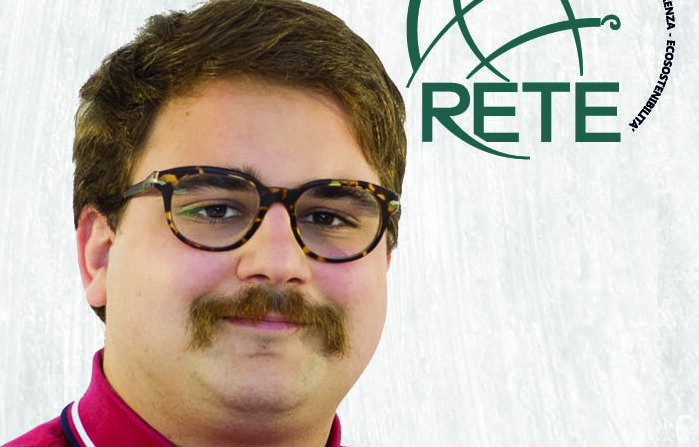
“Those who judge others should at least agree to say who they are.” Giovanni Zonzini, councillor and secretary of Rete, places at the centre of his open letter to media operators the personal attacks published without a byline.
The starting point is the writings of an anonymous columnist in Serenissima Sera. But Zonzini broadens the discussion: readers must be able to know who is writing, in order to assess credibility and any possible interests at play.
“One claims the right to pass any judgment on others, yet takes great care not to offer others the chance to do the same. A rather convenient conception of the freedom of criticism, it must be said.”
Below is his statement in full.
For several days now, an anonymous columnist has been dedicating himself, from the columns of «Serenissima Sera», to a series of personal attacks against me.
I do not intend to return to the substance of his remarks, to which I have already had occasion to respond.
I would rather take this opportunity to dwell on a matter I consider far more general: the use of anonymity to carry out ad hominem attacks in the press.
I have no difficulty accepting not only the harshest criticism, but even personal attacks, as legitimate elements of democratic debate.
What I find hard to understand, however, is why those who claim the right to subject others to public judgment (if not public ridicule) should also claim the right to shield their own identity from the very same scrutiny.
In my view, there is also a fair dose of cowardice in claiming to strike publicly at someone without having the courage to declare who one is.
One claims the right to express any judgment about others, yet takes great care not to offer others the chance to do the same.
A rather convenient conception of the freedom of criticism, it must be acknowledged.
This is not a secondary matter, nor merely a question of good manners.
Behind a pseudonym, anyone could be hiding: a journalist, a political opponent, someone driven by personal interests or, why not, an individual whose reputation alone would be enough to strip his words of all authority.
The point, therefore, concerns not only the person being attacked, but above all the reader.
Knowing the identity of the writer allows one to assess their credibility, their expertise, any vested interests and, not least, the consistency between what they preach and what they practise.
Anonymity deprives readers of these elements, asking them to place trust in an author about whom they know absolutely nothing.
Naturally, there are circumstances in which anonymity is not only legitimate but even necessary.
I am thinking of those who report wrongdoing, abuse or injustice, exposing themselves to the risk of retaliation.
It would, however, be strange to confuse the protection of such people with the choice to hide one’s name in order to dispense judgments and insinuations about others.
I am certainly not proposing to ban pseudonyms, nor to require by law that every article be signed.
I do believe, however, that newsrooms should ask themselves whether it is appropriate to offer their columns to those who, while (legitimately) demanding maximum transparency from others, are not willing to guarantee even that much regarding their own identity.
There is, in all of this, a contradiction I find particularly curious: those who hold public office are rightly expected to account for their choices, their activities and even (as in my case) their private and professional life.
Yet whoever takes it upon himself to judge them claims to do so under the cover of a made-up name, with no one able to know his past or his interests.
That does not strike me as much of a service to transparency.
Freedom of the press certainly includes the right to criticise, to engage in polemics and even to be unpleasant.
I do not see, however, why it should also entail the claim to systematically shield authors from the judgment of readers.
I therefore hope that this episode may offer an opportunity for a broader reflection on the practices of Sammarinese journalism.
Not because personal attacks should be banned, but because it would be desirable for those who make them to publicly take responsibility – political and moral – for their own words.
After all, it is a rather modest request: that even those who judge others should at least agree to say who they are.
Giovanni Maria Zonzini