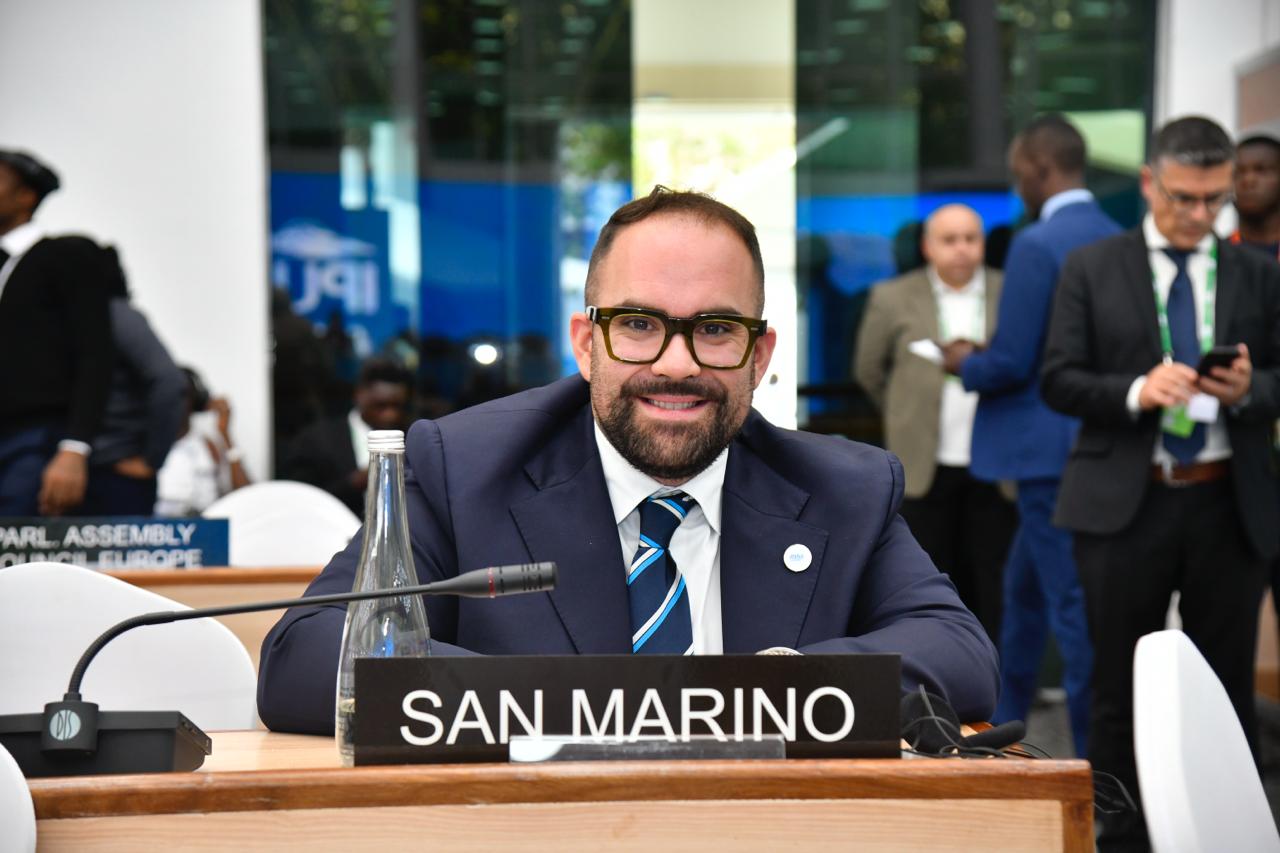
Trust in institutions is built by giving citizens the chance to participate and by asking those who govern to answer for their decisions. That was the core message of the address delivered by Lorenzo Bugli, head of San Marino’s delegation to the 153rd Assembly of the Inter-Parliamentary Union (IPU), held in Arusha, Tanzania, from 5 to 9 October.
Speaking in the general debate, dedicated to good governance, inclusion and opportunities for all, Bugli drew on San Marino’s own experience to show the contribution even a small state can make to international dialogue. “We are small. We know that. But history has taught us one thing: the size of a state does not measure the size of its ideas.”
His starting point was the crisis of trust in governments. Citing data from the OECD’s 2024 survey, Bugli noted that 44% of respondents reported little or no trust in their own government — a gap that shifts sharply depending on whether people feel heard.
“Among citizens who feel they have a say, trust rises to 69 percent. Among those who feel excluded, it plunges to 22. Trust, then, is not a feeling. It is a relationship. And relationships are built in only one way: by listening.”
This led to a reflection on the accountability of those who hold power, illustrated through two of San Marino’s institutions: the six-month Captains Regent and the Arengo Assembly. “Since 1243, our Republic has been led by two Heads of State, the Captains Regent. They remain in office for six months. Not one day more. And at the end of their mandate, they must answer for what they have done. Power that is brief, shared and accountable. It is an old idea. It is an idea that does not age.”
The Arengo Assembly, Bugli explained, allows citizens to petition the institutions directly twice a year, with the guarantee that every request will be examined.
Another part of his address focused on the presence of young people in parliaments. Bugli cited IPU data on the limited representation of those under 30, recalling his own experience as Captain Regent at the age of 31.
“I had the honour of serving my country as Head of State at thirty-one. I say this not to boast, because it is no personal merit of mine. It is proof that it can be done. A parliament that excludes the generation that will live longest with its decisions is not governing. It is merely administering the present at the expense of the future.”
Bugli also recalled the words of Pope Leo XIV during his visit to San Marino, referencing the Pope’s description of the Republic as a potential “laboratory of good politics” — a notion tied to the need to assess the effects of public choices and correct course when necessary.
“A laboratory, colleagues, does not claim to have all the answers. It experiments. It measures. It corrects. That is what this debate asks of us: decisions grounded in evidence, the honesty to evaluate outcomes, and the humility to change direction.”
The speech also touched on San Marino’s tradition of welcome, recalling the refugees sheltered by the Republic during the war in 1944, as well as the relationship between technology and democracy. For Bugli, technological tools must remain at the service of people: “It can bring institutions closer to citizens, or drown them in noise. It can widen participation, or merely create the illusion of it. It must remain at the service of the person.”
He closed by returning to the bond between freedom, trust and political responsibility. “Trust is not decreed. It is earned. One decision at a time. One citizen at a time,” Bugli said, before invoking the words tradition attributes to San Marino’s founder, Saint Marinus: “Relinquo vos liberos.”
“We will not be remembered for the power we wielded. We will be remembered for the freedom — and the trust — we leave to those who come after us.”