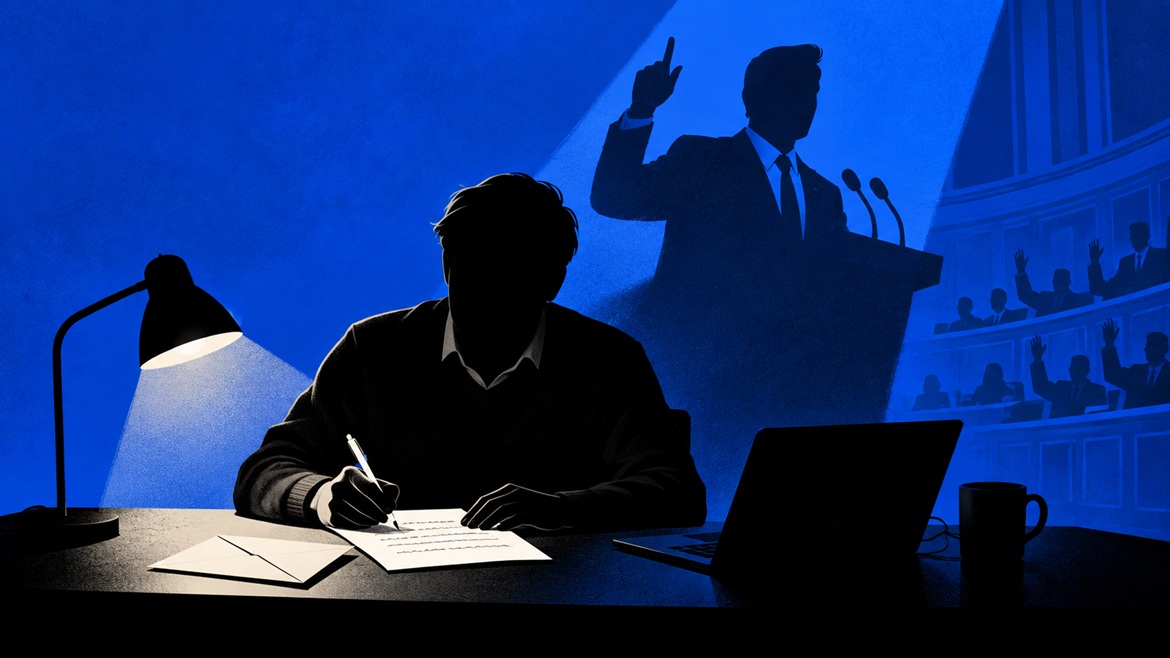
There’s a literary genre that does very well in San Marino: the letter from the simple, disappointed voter who, read closely, is only “simple” in name. You can spot it from one detail: it knows too much. And those who know too much sometimes don’t stop at voting — they do politics. We say this with full knowledge of the matter, because it happened to us too.
We won’t say when or who — partly out of caution, partly because the point isn’t who. It’s how. And the how, in these letters, is always the same.
They haven’t read about it: they remember it. The ordinary reader writes “I read that.” The overly attentive one writes like someone who was there: the assemblies, the raised hands, the things that have always been discussed inside. Ask them where they were sitting, and they’d probably tell you.
At some point, they switch to “we.” Not the broad “we” of citizens, the kind you hear at the bar, but the “we” of the meeting room. They learn the news together with the chairman and the executive board — as commonly happens, apparently, to every ordinary voter.
They don’t have an opinion: they have the line. The ordinary reader says what they think. The overly attentive one says what must be thought, distinguishing with notarial precision what the party asked for and what, heaven forbid, it never asked for.
They criticize the party in one line and praise it for a whole paragraph. The criticism is generic, with no example, tossed in for the sake of appearing balanced. The praise is detailed, heartfelt, press-release-ready.
They sign with the party. The ordinary reader signs with their own name, or doesn’t sign at all. The overly attentive one, in the end, puts the party’s name where their own should be. It’s the most honest detail in the entire letter.
Let’s be clear: none of these clues is proof, and an unsigned letter isn’t a crime. Nor is it a scandal for a politician to write to the papers. Politicians write in these very pages too, and they’re recognizable at first glance, because they put their name and face to it.
The problem is the disguise. Someone who does politics and presents themselves as a disappointed voter isn’t defending an idea. They’re borrowing the voice of those who cast the vote, to reinforce the voice of those who ask for it.
In a country where everyone knows everyone, besides, the disguise doesn’t last long: about as long as it takes to read the letter, and then someone recognizes you by your punctuation.
That’s why, ever since it happened to us, the rule is simple: we publish letters, even unsigned ones when necessary, but we must know who is writing. And if the writer is a politician, our readers will know it too.
Those who remind others how much a raised hand is worth should know better than anyone: it’s worth just as much at the bottom of a letter.
It’s called a signature.
Francesca Devincenzi
Editor of Insider.sm