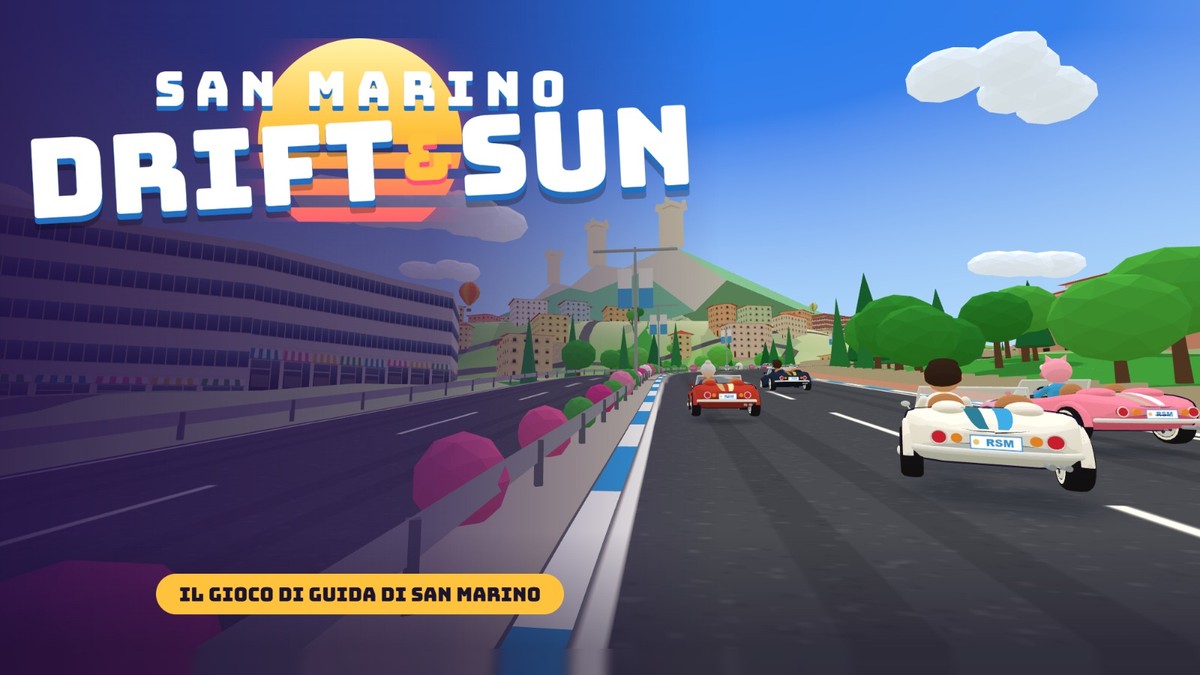
A few days ago I published San Marino Drift & Sun online.
As far as I can tell, it’s the first video game ever set in San Marino — a small Guinness-style record, Titano edition. You start just outside the Dogana border and make your way to Piazza della Libertà, passing through the Bustrac bend.
I built it quickly, mainly to entertain Sammarinese players — and not only them.
Within a few days, about a thousand people had played it.
That’s no chart-topping number, but for a free game, made almost as a joke and without a single euro spent on promotion, it’s a clear signal: there is an appetite for seeing San Marino told in new ways, and a real interest in innovation.
No one played it because it was perfect — it isn’t. They played because it was ours: recognisable streets and likeable characters that playfully caricature our territory. When a country sees itself represented in a contemporary language, it responds.
And this is far from a niche market. In Italy alone, 14.2 million people play video games, in a market worth around €2.4 billion. Globally, there are roughly 3.6 billion gamers, and in 2025 the industry surpassed $200 billion in value for the first time.
The second lesson concerns cost.
GTA 6, released on 19 November, generated $3.79 billion in first-day sales, pre-orders included, according to Rockstar and Take-Two, after a development budget estimated between $1 and $1.5 billion. That’s a different league entirely, and no one is suggesting we compete in it.
But until recently, even a simple game required months of work and a real budget. Today, with a small team and the help of AI, you can get to a playable prototype in a matter of days. The cost of experimenting has dropped to nearly zero, and the real risk now is not trying.
Then there’s tourism, and here the conversation turns political — in a good way. San Marino already attracts a huge number of visitors: the 2027 Economic Programme points to record arrivals and overnight stays. The next challenge is converting more of those visits into actual stays: in 2025, overnight arrivals numbered 123,087, with an average stay of 1.74 nights — and there’s clearly room to grow.
A well-designed digital tool can build a connection before a visit even happens, draw attention to places beyond the historic centre, and give people one more reason to stay longer or come back.
Japan understood this: on the island of Tsushima, the developers of the game set there were made permanent ambassadors.
Ideas aren’t in short supply: the Economic Programme itself speaks of “regulatory sandboxes” to attract tech startups. What’s missing is a method — and often, speed.
What would help are small, fast, open calls for digital prototypes on tourism, culture and education; maps and archives made available to anyone wanting to build something; serious games on the Republic’s history or road safety; and above all, measuring the results of every publicly funded promotional initiative.
San Marino will never make a GTA, and that’s perfectly fine. But a small country has an advantage that larger ones can only dream of: speed.
If a thousand people are willing to drive the Superstrada just for fun, perhaps the problem isn’t a lack of interest, but a lack of will. The question for our institutions is simple: are we ready to start playing too?
Nicholas Perpiglia