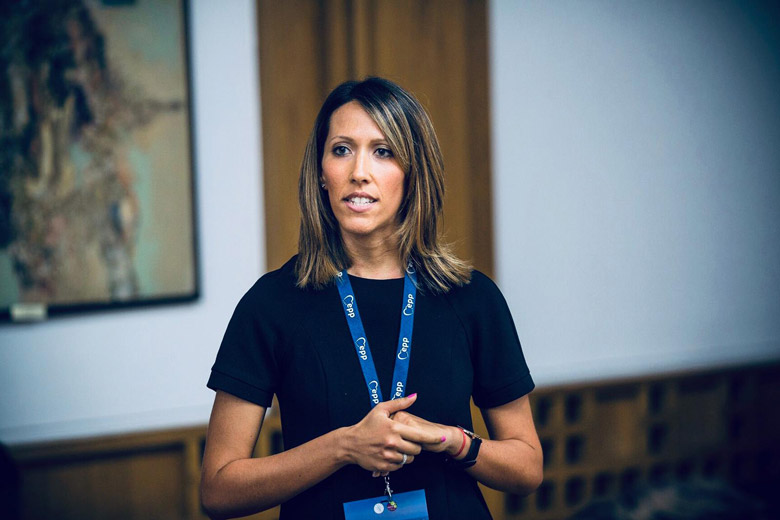
The Association Agreement with the European Union marks a historic milestone for San Marino, but the opportunities it brings will depend on the country’s ability to make the most of them. That is the message delivered by Alice Mina (Pdcs) during her address yesterday before the Foreign Affairs Committee, as reported by Askanews.
The Christian Democrat councillor urges a confident outlook on European integration, rather than viewing it as a threat to San Marino’s sovereignty. The shift from third country to associated state, she notes, opens up new prospects for citizens and businesses alike, but will also require a cultural and administrative transformation.
Mina places particular emphasis on the phase that will follow the signing of the agreement: there will be a need for training, support for businesses, streamlined procedures and tools to monitor the agreement’s effects. Because, she points out, the negotiation creates the conditions for new opportunities, but it does not automatically guarantee results.
Below is her speech in full.
Alice Mina (Pdcs):
I want to look at this country’s present and future with positivity and optimism, because that is precisely what we are discussing today.
This morning, while checking some information on Instagram, I came across a post from the European Commission’s representation in Italy, published a few days ago, titled “European enlargement has entered a new phase.”
It describes the experience of four countries — Montenegro, Albania, Moldova and Ukraine — which are in a new phase of rapprochement and integration with the European Union.
Today, we too can say that we are entering a phase of greater integration, clearly not through accession, but through an Association Agreement.
I believe this is history in the making, something very important that deserves to be recognised.
San Marino has an extraordinary history, a sovereignty preserved over the centuries, a strong and distinctive identity, and a heritage of values that represents a unique asset.
If there is one lesson history teaches us, it is that we have managed to survive, preserve our freedom and grow precisely because we have known how to read the changes around us and adapt to shifts in the international context without ever losing ourselves.
This is the awareness that should guide us as we look to the future and assess the significance of the Association Agreement.
We must first make a cultural effort to shift our perspective.
Europe must not be experienced as a threat to our identity or sovereignty, but as a space in which San Marino can find new opportunities, strengthen its economy, showcase its skills and offer greater prospects to citizens and businesses.
I want to look at the agreement in this way, with this optimism and this positivity.
On a reciprocal basis, the agreement enshrines the principle of non-discrimination and guarantees access to the four fundamental freedoms.
The shift from third country to associated state represents a watershed moment, one that profoundly changes our relationship with the European and international context.
There is another important point to highlight: San Marino reaffirms its desire to belong to a framework built on shared, clear and transparent rules.
The European Union represents a framework of rules, principles and guarantees within which our country consciously chooses to position itself.
A context in which to operate with clarity, without ambiguity, with transparency, consistency and responsibility.
This is also an important choice for the Republic’s image and international credibility.
San Marino wants to be a reliable country, one that respects the rules, offers certainty to those who invest, work and do business, and is ready to engage with the opportunities and responsibilities of a wider European space.
We must not experience common rules as a limit to our autonomy, but as a guarantee of certainty, reliability and equal opportunity.
This does not mean believing that the agreement will automatically solve all our problems, nor that results will simply arrive because a negotiation has been concluded.
The agreement creates the conditions for building new opportunities, but it does not determine the future on its own.
Others before me have said this, our Excellencies have said it, as have the scholars who are consulted on this every day.
It is worth repeating: the real difference will be made by our ability to implement the agreement, seize its potential and turn it into concrete results.
This is where the true challenge begins: it is no longer simply about having negotiated a good agreement, but about knowing how to implement it in the interest of the country and its citizens.
This will require a collective effort, a long-term vision and, above all, a shift in the way we think and govern.
We will need to get used to thinking on a broader scale, overcoming rigidity and the tendency to see what is new as a problem rather than a possibility.
We will need to look beyond our borders, engage with different realities and measure ourselves against wider standards and opportunities.
This is a path that must be supported: it will be essential to build a concrete support system for citizens, businesses and the public administration, through training, technical assistance, simplified procedures and adequate support tools.
At the same time, the Government and Parliament need to set goals, priorities and indicators to periodically monitor the implementation of the agreement and verify its concrete effects over time.
We must guide this change, correct what does not work and build on what delivers results.
The launch of the website published a few days ago is also very interesting: a step forward in the relationship with citizens and businesses, aimed at sharing ever greater awareness and information.
In conclusion, I believe that for a small state like ours, the riskiest choice is not opening up to the world, but thinking we can keep growing while standing still.
Our history has taught us that preserving our identity does not mean remaining motionless, but rather having the ability to navigate change while holding firm to our values.