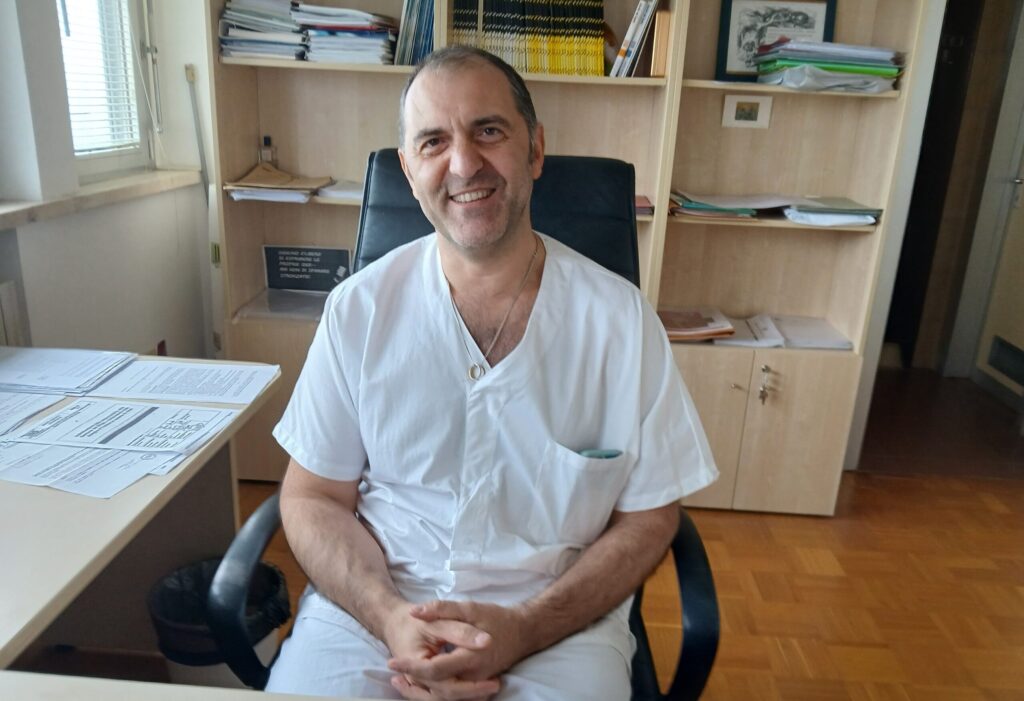
The possible early return of Giovanni Landolfo to the State Hospital dominated discussion in the Joint Committee session held today, Wednesday 14 October.
The surgeon wants to come back to work after a period of leave, but reports of possible obstacles to his return have ignited debate within the joint Foreign Affairs and Health Committee. Opposition members say it must be clarified whether political interference lies behind the difficulties.
Secretary of State Massimo Andrea Ugolini rejected calls for political intervention in Landolfo’s return, arguing that the matter should be resolved by the general management and executive committee of the Social Security Institute (ISS), balancing the professional’s request with the department’s operational needs.
“A matter concerning a professional and his own independent request for a period of leave is an administrative issue.” Ugolini pointed out the contradiction of asking politics to step in at the very moment its interference in healthcare is being criticised: “We always complain that, as politicians, we barge into healthcare professionals’ clinical decisions.”
The real issue, he explained, is that during the leave period the department had to reorganise itself to keep services running.
An early return therefore requires checks on timing, staff replacements and the applicable rules, which the secretary said are not entirely clear in cases of prolonged absences by department heads. “A complex operating unit within a public institution must guarantee a service, and therefore must organise itself accordingly.”
For Ugolini, acknowledging Landolfo’s value does not mean skipping these procedural steps: the contribution of professionals who have worked for years at the hospital is not in question, but the decision on his return must remain with the administration.
“So let the Social Security Institute’s structures and general management do their job, because these are administrative responsibilities. It is not for politics to weigh in on the voluntary choices of individual professionals.”
The issue was raised by Miriam Farinelli (RF), who focused on respecting the rights and competencies of healthcare staff.
A professional, she noted, must be able to request leave and return earlier than planned without facing retaliation. “An authoritative administration is not one that demands uncritical obedience, but one capable of explaining its decisions, taking responsibility where due, and ensuring clear rules applied consistently.”
Nicola Renzi (RF) demanded a precise answer: is it true that a doctor wants to return to service and is encountering bureaucratic obstacles? For Renzi, the ability to retain professionals depends not only on salary but also on the recognition given to their role.
Ugolini defended the distinction between political responsibilities and hospital management. He recalled that during the department head’s absence, the unit had to reorganise to maintain services, and that the conditions for his return must now be assessed.
The surgeon’s worth is not in question, he stressed, but the solution falls to the executive committee and general management. “It is not for politics to weigh in on the voluntary choices of individual professionals.”
It was precisely this point that prompted a reaction from Gaetano Troina (D-ML). “Politics cannot interfere in healthcare on a daily basis and then claim it cannot act when the opposition raises concerns.” For Troina, asking for explanations about the return of a department head universally recognised as a top-level professional means addressing a matter of public interest.
And, with a hospital in need of doctors, he added, bureaucratic issues must be resolved.
Matteo Zeppa (Rete) likewise challenged the secretary’s response. He argued that political interference in healthcare has existed for some time and must be tackled as it arises, rather than letting tensions drag on. His reasoning starts with the nature of leave itself: someone who requests it does not resign, so the organisation must plan for their eventual return. “The department reorganises because the person has not lost the right to work or to return to their previous position.”
Even more direct was Matteo Casali (RF), who accused the government of applying double standards. When the opposition flags a problem, he observed, it is told to respect the ISS’s autonomy; yet when politics intervenes in how services are organised, that boundary seems to disappear.
“This on-again, off-again interference is rather ridiculous.” For Casali, the Landolfo case also touches on San Marino healthcare’s ability to attract and retain qualified doctors — a subject on which politics must be accountable.
Emanuele Santi (Rete), however, drew a line between accusations and facts still to be verified. The professional’s return, he said, appears to be facing obstacles, but it is up to the government or ISS leadership to clarify whether the circulating information is accurate. “If it isn’t true, then prove us wrong.” The question remains: why does a supposedly administrative matter become a political battleground?
From the majority benches, Andrea Ugolini (PDCS) pointed to the needs of the department and of those who stepped in to replace the department head. An early return, he explained, requires assessment by the relevant manager, who must take into account the organisational arrangements built in the meantime and the replacements already in place.
He reiterated his esteem for Landolfo, with whom he worked for fifteen years, but said he does not necessarily see political motives behind checks on the timing of the return. “Over the past year and a half, the complex surgical operating unit has carried out its work, and I thank all the professionals who strove to do so in the best possible way.”
Francesca Civerchia (PDCS), for her part, challenged the premise of the controversy: she said she had received no confirmed reports of an actual block on Landolfo’s return, only of checks on timing. “It seems fairly well established that Dr Landolfo will return to carry out his role.”
She called for rights and rules to be respected without turning still-uncertain information into a dispute that risks undermining public trust in the hospital.
Matteo Rossi (PSD) also spoke in support of the government’s position. In his view, the discussion is still based on rumours and corridor talk. Decisions, he said, must remain with the competent administrative authorities, without a council member or Secretary of State determining who may or may not return.
Rossi acknowledged the surgeon’s popularity and merits but added that even healthcare staff should avoid seeking political backing to resolve professional matters.
Maria Luisa Berti (AR) finally called for Landolfo’s return to be facilitated, with any work-related issues handled at a technical level.
“When there is an opportunity for professionals like Dr Landolfo — who chose to practise outside our institution — to return, I believe it should be welcomed wholeheartedly, precisely because Dr Landolfo represents real added value.”