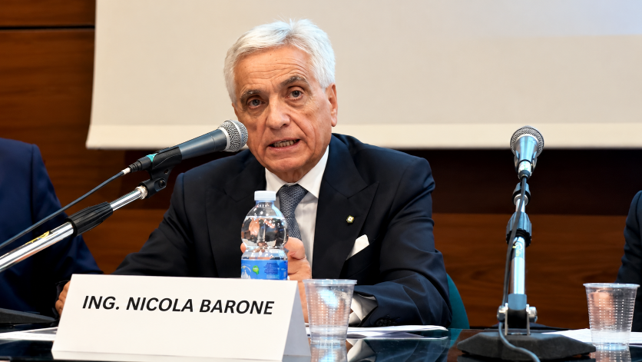
San Marino could become a European laboratory for digital sovereignty – a place where fibre, 5G, public services and new infrastructure come together to give citizens and businesses greater control over the technologies they depend on. That is the proposal put forward by engineer Nicola Barone, who spoke yesterday afternoon on Mount Titano at the presentation of the critical edition of the biography of Alcide De Gasperi, written by Igino Giordani in 1955. His remarks were published by Il Domani d’Italia.
Barone starts from San Marino’s own infrastructure. He points to full fibre-to-the-home coverage and 5G, the planning of a national data centre, and the scheduled switch-off of the copper network, with the eight exchanges serving the nine Castelli moving over to fibre. On this foundation, he argues, the country can test a transition that combines technological autonomy, digital services and sustainability.
The key issue, he says, is the ability to choose: where data is stored, what rules govern its use, and which networks essential services run on. For Barone, talking about digital sovereignty does not mean manufacturing every component within Europe or cutting ties with the rest of the world. It means making sure dependence on a given technology never becomes a point of weakness.
“Sovereignty is really the capacity to choose,” he says. “It also means having enough skills, infrastructure and technology so that we’re never in a position where someone else gets to decide for us.”
This is where the link to De Gasperi comes in. In the postwar years, pooling coal and steel meant sharing resources that were decisive for industry and military power. Today, in Barone’s reasoning, the same logic applies to microchips, cloud computing, artificial intelligence and telecommunications. The technologies change, but the need to tackle challenges too big for any single European country to face alone remains.
“There’s no need to recover twenty-seven separate national technological sovereignties – what’s needed is to build a European capability,” the engineer argues. The Union’s single market, its businesses, universities and infrastructure together offer a scale that no member state possesses on its own. The real challenge is turning that potential into concrete tools.
Barone also cites Mario Draghi’s analysis of European competitiveness: closing the innovation gap, reducing strategic dependencies and decarbonising the economy. He recalls the estimate of €750-800 billion a year in additional investment needed to meet Europe’s targets across various sectors.
On digital technology, however, the gap to those targets remains wide. According to the figures Barone cites, cloud computing is used by 46.7% of businesses, while artificial intelligence has been adopted by roughly one company in five. Europe’s share of the global semiconductor market stands at around 9%, against a target of 20% by 2030.
The proposal, then, is to build autonomous European capacity in critical infrastructure – from large computing centres to the cloud, right through to semiconductors. For Barone, this is a question that bears directly on rights and democracy too: “Whoever controls this infrastructure inevitably wields a form of power.”