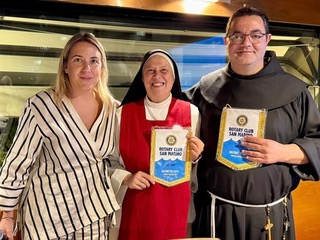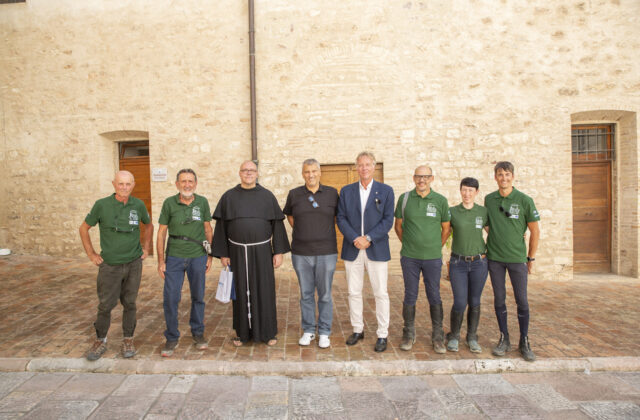
An evening dedicated to the figure of St Francis and the enduring relevance of his message, drawing parallels between Franciscan values and the community service ethos that defines Rotary. This was the guiding theme of the dinner meeting organised on Monday, 5 October by the Rotary Club San Marino, titled “St Francis: A life in the service of others. Uniting people, building the common good.”
The evening, the Club reports, “offered members and guests a profound reflection on the common ground between the Franciscan charism and the spirit of service that animates the Rotarian movement.”
The evening was opened by club president Giulia Magnani, who in her address dwelt on the timeliness of St Francis’s message. According to the statement, “the President highlighted how Francis’s vocation to draw close to others and build bridges between people represents an ideal guide and a daily inspiration for anyone wishing to act concretely for the good of the community, placing the needs of others above their own interests.”
The discussion then moved into its central theme with contributions from Sister Maria Gloria Riva, Mother Superior of the Nuns of Perpetual Adoration, and Father Ignazio Faraci, superior of the Franciscan Friars Minor community of Valdragone.
Sister Maria Gloria Riva retraced Francis’s choice to abandon the comforts and privileges of his youth in favour of a life of poverty and sharing. Her reflection centred in particular on four concepts: truth, justice, fraternity and usefulness.
In the statement, truth is described as “an authentic search for and profound adherence to reality,” while justice is interpreted as “a rigorous ethic of behaviour and unconditional respect for the dignity of every person.” Fraternity, meanwhile, is presented as the capacity to build “positive relationships capable of erasing social and cultural distances,” while usefulness is translated “into diligent, selfless service to one’s neighbour.”
Father Ignazio Faraci then addressed the relationship between the Franciscan charism and contemporary society, starting from the fraternity lived out in everyday life. According to the Rotary Club, the friar emphasised that “Francis’s teaching is not an abstract ideal, but a call to action that passes through genuine listening to others, unconditional acceptance and the overcoming of divisions.”
Part of his address was devoted to the wounds of St Francis — not only the stigmata received on Mount La Verna, but also the inner struggles and vulnerabilities that marked his journey.
“The Superior of Valdragone pointed out that it is precisely the acceptance and transfiguration of these wounds that make Francis extraordinarily close to people of every era,” the statement reads, adding “that the true strength of a community lies in its capacity to bear the wounds and fragilities of its land with quiet, steadfast dedication.”
In her closing remarks, president Giulia Magnani thanked both speakers for their contributions and for connecting the historical and spiritual dimensions of Franciscanism with the issues of today. The dinner meeting, the Rotary Club San Marino statement concludes, left participants with “a renewed moral commitment to translating the values of unity, ethics and service into action.”